
Disclosure: This post contains affiliate links. If you purchase through these links, we may earn a commission at no additional cost to you.
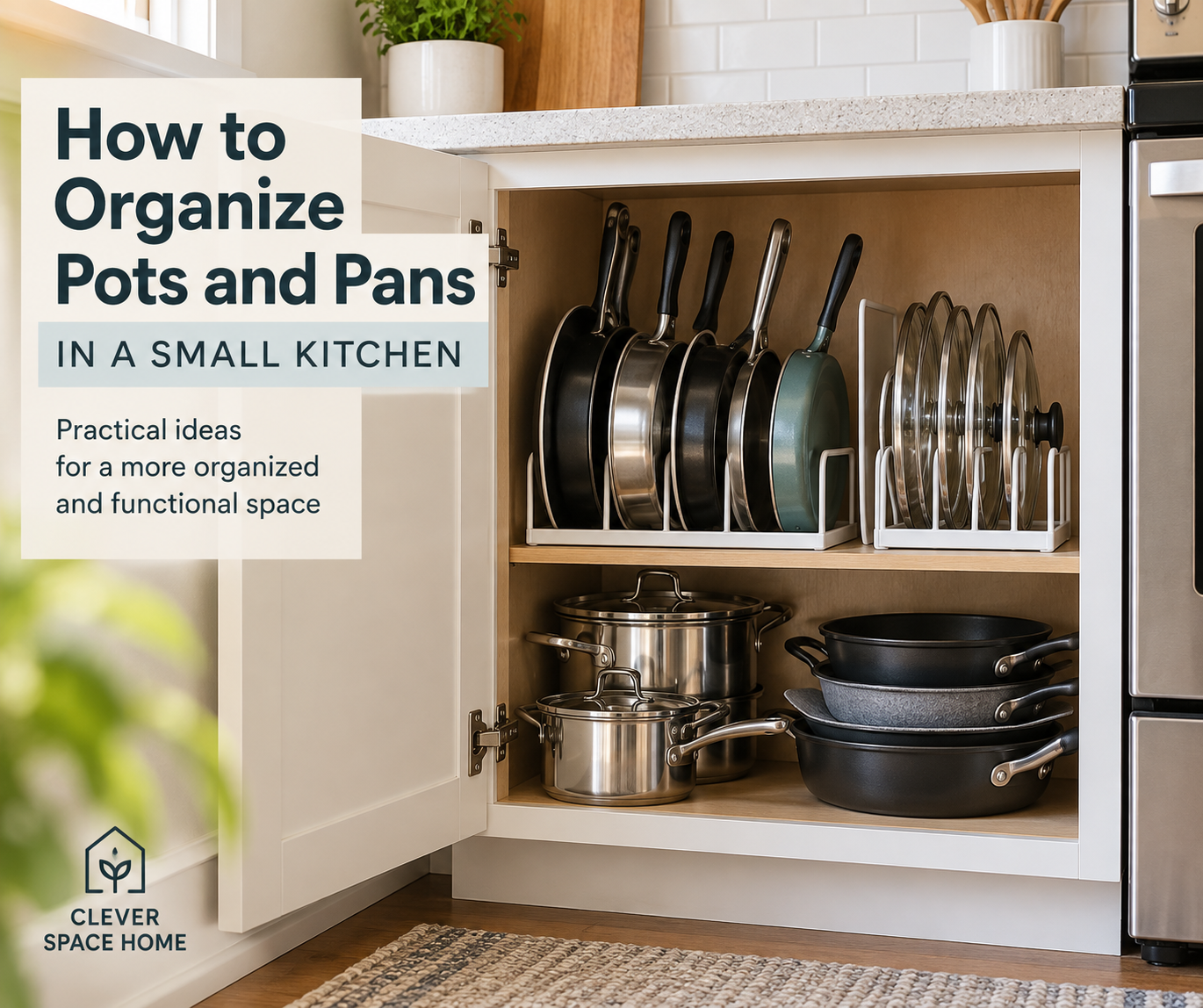
Pots and pans are some of the most difficult items to organize in a small kitchen. They are bulky, come in different shapes and sizes, and often have long handles that make efficient stacking difficult. Add a collection of lids, and one cabinet can quickly become frustrating to use.
The answer is not necessarily to buy a large cookware organizer. A better approach starts with deciding which cookware you actually use, choosing the most suitable storage location, and arranging pots, pans, and lids according to the space available in your kitchen.
In this guide, we’ll explain how to organize pots and pans in a small kitchen using practical methods such as nesting, vertical storage, lid organization, pull-out systems, and carefully selected organizers. The goal is to make everyday cookware easier to reach without sacrificing more kitchen space than necessary.
Table of Contents
Why Pots and Pans Are Difficult to Store in a Small Kitchen
Cookware creates several storage problems at the same time. Frying pans may be wide but relatively shallow, stockpots can be tall, saucepans have projecting handles, and lids rarely stack neatly with the cookware they belong to.
Many households also accumulate more cookware than they regularly use. New pans are added while older ones remain in the cabinet, specialty cookware may occupy valuable space despite being used only occasionally, and duplicate sizes can make stacks unnecessarily tall.
In a small kitchen, these problems are amplified because cookware competes with dishes, food, appliances, and other essentials for limited cabinet and drawer space.
The best system therefore begins with the cookware itself rather than with an organizer.
Step 1: Take Out All Your Pots, Pans, and Lids
Start by removing the cookware from its current storage area so you can see the entire collection together.
Group similar items: frying pans, saucepans, larger pots, specialty cookware, and lids. Match lids with their corresponding cookware where possible.
This makes duplicates and rarely used pieces easier to identify. You may discover several pans that perform almost the same function or lids that no longer match anything you own.
Check the condition of each item as well. Cookware that is damaged should be assessed according to the manufacturer’s instructions and the type of material or coating involved.
The purpose of this step is not to reduce your cookware to an arbitrary number. It is to make sure the limited storage space in your kitchen is being used for items that genuinely serve a purpose.
Step 2: Decide Which Cookware Deserves the Best Storage Space
Not every pot or pan needs equally convenient storage.
Cookware used several times a week should generally occupy the easiest-to-reach location. Items used occasionally can often be stored higher, lower, or farther back if those locations remain safe and practical.
Specialty cookware that is used only a few times a year may not need to occupy the same prime cabinet space as your everyday frying pan and saucepan.
Consider weight as well as frequency. Heavy cookware should be stored where it can be lifted and returned safely without awkward reaching.
Try to avoid creating a system in which your most frequently used pan sits underneath several heavy pots. An organizer is not successful if you need to dismantle it every time you cook.
Step 3: Choose the Best Cabinet or Storage Zone
Once you know which cookware you use most often, choose the most practical storage area.
A lower cabinet near the main cooking area is often convenient because pots and pans can be relatively heavy. However, the best location depends on your kitchen layout, cabinet dimensions, and available storage.
Measure the usable width, depth, and height of the cabinet rather than estimating. Also measure the opening itself because hinges, frames, plumbing, shelves, or other features may reduce the usable space.
If your cabinets are generally difficult to organize, our guide on how to organize kitchen cabinets in a small kitchen explains how to create practical storage zones and make better use of cabinet height and depth.
Avoid forcing all cookware into one cabinet simply because that is where pots and pans have traditionally been stored. In a very small kitchen, separating everyday cookware from occasional pieces can sometimes produce a more practical arrangement. If food storage is competing with cookware for limited cabinet space, our guide on how to organize a small kitchen without a pantry can help you create a more dedicated food-storage system elsewhere in the kitchen. Avoid moving rarely used cookware permanently onto the countertop just to clear a cabinet. Our guide on how to organize a small kitchen counter explains how to protect valuable preparation space while deciding what genuinely deserves to stay visible.
Step 4: Decide Between Nesting and Vertical Storage
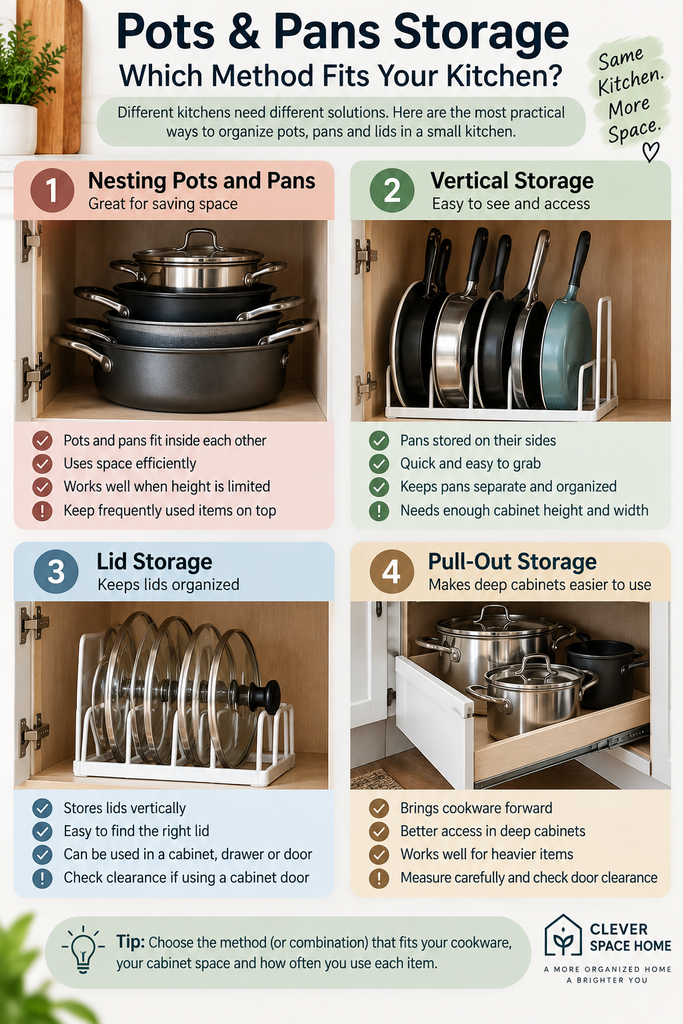
Two of the most practical approaches for storing pans are nesting them together or storing them vertically.
Nesting Pots and Pans
Nesting works well when cookware fits comfortably inside other pieces. Larger pots or pans form the base while progressively smaller items sit inside them.
This can use cabinet space efficiently, especially when vertical height is limited.
The disadvantage is access. If the pan you use every morning is at the bottom of a five-piece stack, you may repeatedly lift everything above it.
If you choose nesting, arrange cookware according to frequency so commonly used pieces are not unnecessarily difficult to reach.
Also take care when stacking cookware with surfaces or finishes that could be damaged through contact. Follow the cookware manufacturer’s care instructions and use appropriate protection when necessary.
Vertical Pot and Pan Storage
Vertical storage places pans on their sides, usually in separate sections created by a rack or divider.
This approach can make individual pans easier to remove because you do not need to lift an entire stack.
However, vertical racks require sufficient cabinet height, width, and depth. Long handles also need somewhere to go without preventing the cabinet door from closing.
Measure your cookware as well as the cabinet before purchasing a vertical organizer.
The better method is the one that makes your particular cookware easier to retrieve while fitting the available space—not simply the system that looks better in photographs.
Step 5: Store Lids Separately When It Improves Access
Lids often make cookware storage more difficult because handles and knobs prevent them from stacking efficiently.
Instead of keeping every lid directly on its pot or pan, consider creating a separate lid-storage area.
A vertical lid organizer can keep several lids upright. A suitable cabinet-door organizer may use otherwise empty space, while a drawer can work when it is deep enough and the lids fit safely.
You can also store lids beside vertically arranged pans if the organizer provides suitable sections.
Keep frequently used lids easy to identify. If you repeatedly need to test several lids before finding the correct one, the system may need clearer grouping.
Before using the inside of a cabinet door, check clearance carefully. The organizer and lids must not collide with shelves or cookware when the door closes, and the door hardware should be suitable for the added load.
Recommended Product: DMLBST Pot Lid Organizer
Pot lids can make a cookware cabinet difficult to manage because their handles and different sizes prevent them from stacking neatly. Storing lids vertically in a dedicated organizer can make individual lids easier to see and remove without disturbing the rest of the cookware.
This approach can work particularly well when you have several frequently used lids but limited cabinet space. Before choosing an organizer, check the available cabinet dimensions and the size and shape of your lids to make sure they will fit comfortably.
Check the DMLBST Pot Lid Organizer on Amazon → (paid link)
Step 6: Make Deep Cabinets Easier to Use
Deep lower cabinets can hold substantial cookware, but items at the back are often difficult to reach.
One simple approach is to keep frequently used pots and pans toward the front and occasional cookware toward the back.
Pull-out organizers can make deeper storage more accessible by bringing cookware forward. Some systems are designed specifically for pots and pans, while others provide general sliding shelves.
These solutions can be useful, but accurate measurements are particularly important. Check the cabinet opening, internal width and depth, hinges, door clearance, and the weight capacity of the organizer.
A pull-out system that technically fits inside the cabinet may still be unsuitable if it cannot extend properly past the door or cabinet frame.
If you do not need a permanent installation, simpler removable racks may provide enough organization without modifying the cabinet.
Step 7: Use Cabinet Height More Efficiently
A tall lower cabinet may have substantial unused space above a short stack of pans.
An adjustable pot-and-pan rack can sometimes use this height by creating several storage levels. Certain designs allow pans to be stored vertically, horizontally, or in a combination of both.
A shelf may also divide a tall cabinet into more usable levels if the cabinet design permits it.
Do not add extra levels simply because space exists above the cookware. Make sure each stored item remains reasonably easy to remove and replace.
If an organizer creates narrow openings that make larger pans difficult to maneuver, the additional storage capacity may not be worth the inconvenience.
Step 8: Consider Drawers for Cookware Storage
Deep kitchen drawers can be excellent for pots and pans because they allow you to see much of the contents from above.
If you have a suitable drawer near the cooking area, it may provide easier access than a deep cabinet.
Arrange cookware so that the drawer can open and close smoothly without handles or lids catching against surrounding surfaces.
Heavy cookware requires particular attention. Check the drawer or cabinet manufacturer’s specifications when available and avoid loading a drawer beyond its intended capacity.
Drawer dividers or suitable organizers may help keep lids and pans separated, but they should not prevent the drawer from closing properly.
Step 9: Use Wall or Hanging Storage Only When It Suits the Kitchen
Wall-mounted racks, rails, pegboards, and hanging pot racks can free cabinet space, but they are not automatically suitable for every small kitchen.
Open storage works best when there is a safe location that does not interfere with walking, cooking, cabinet doors, windows, or other everyday activities.
Cookware must also be supported by hardware appropriate for its weight and installed correctly for the wall or mounting surface.
A hanging system may be particularly useful for a small number of frequently used pans. Hanging an entire cookware collection, however, can make a compact kitchen feel visually crowded.
Think of wall storage as an alternative location for selected pieces rather than a requirement for small-kitchen organization.
Recommended Product: Toplife Wall-Mounted Pot and Pan Rack
When cabinet space is extremely limited, an unused section of wall can provide another place to store frequently used cookware. A wall-mounted hanging rack keeps pots and pans accessible while freeing cabinet space for items that are harder to store elsewhere.
Wall storage should be used selectively in a small kitchen because too many visible items can make the room feel cluttered. Check the rack’s dimensions, installation requirements, wall construction, and weight capacity before installation, and make sure hanging cookware will not interfere with doors, appliances, or normal movement through the kitchen.
Check the Toplife Wall-Mounted Pot and Pan Rack on Amazon → (paid link)
Step 10: Protect Cookware When Stacking
Space-saving storage should not shorten the useful life of your cookware.
When pans are nested or stacked, their surfaces can come into contact. Depending on the cookware material and finish, this may cause scratching or other damage.
Follow the manufacturer’s care and storage instructions for your particular cookware. For example, Le Creuset’s cookware care guidance recommends using a suitable cookware protector between pieces when stacking cookware to help prevent scratching or chipping.
When appropriate, pan protectors or other suitable soft separators can create a barrier between stacked pieces. Some people also use clean, appropriate soft materials already available at home, provided they do not create a storage or safety problem.
Do not add thick separators unnecessarily if they make stacks unstable or consume so much height that the cabinet becomes harder to use.
The objective is to balance protection with efficient storage.
Recommended Product: BOYAN Pan Protectors
Nesting cookware is one of the simplest ways to save cabinet space, but stacking pans directly against each other can cause unnecessary rubbing and scratching. Soft pan protectors create a layer between pieces of cookware while still allowing them to be nested together.
They can be particularly useful for cookware with surfaces you want to protect while avoiding the additional cabinet space required by a large rack. Place a protector between each stacked pan and adjust the arrangement so the stack remains stable and easy to lift.
Check the BOYAN Pan Protectors on Amazon → (paid link)
Best Organizers for Pots and Pans in a Small Kitchen
There is no single organizer that works for every cookware collection. Choose according to the problem you actually need to solve.
Adjustable Pot and Pan Racks
Adjustable racks can separate pans and sometimes allow a combination of vertical and horizontal storage.
They are useful when stacked cookware is difficult to access, but dimensions and stability matter. Compare the organizer’s usable sections with the sizes of your actual pans.
Vertical Pan Organizers
Vertical organizers store pans on their sides so individual pieces can be removed without lifting a stack.
They can work particularly well for frying pans, baking pans, and some lids when sufficient cabinet height is available.
Lid Organizers
Dedicated lid racks can prevent lids from becoming mixed throughout a cookware cabinet.
Options include freestanding racks, drawer organizers, and suitable door-mounted systems. Choose according to the number and dimensions of the lids you actually use.
Pull-Out Cabinet Organizers
Pull-out systems can improve access in deep lower cabinets.
They are potentially valuable for heavier cookware because the contents can be brought forward, but installation requirements, dimensions, clearance, and weight capacity should be checked carefully.
Pan Protectors
Pan protectors can separate nested cookware when protection between surfaces is appropriate.
They require very little additional storage space compared with larger organizing systems and may be useful when nesting is already the most efficient arrangement.
What About Corner Cabinets?
Corner cabinets can provide substantial storage but are often awkward for pots and pans because part of the space is difficult to reach.
If your kitchen has a rotating corner shelf or another built-in access system, larger cookware may fit well there provided the shelves can safely support the weight and the items do not interfere with movement.
In a standard deep corner cabinet, avoid pushing frequently used cookware into areas that require you to remove several other items first.
Consider reserving harder-to-reach sections for lightweight or occasional cookware while keeping everyday pans closer to the opening.
The ideal arrangement depends heavily on the cabinet design, so measure and test the space before purchasing a specialized corner organizer.
Common Mistakes When Organizing Pots and Pans
One common mistake is buying a rack before measuring the cabinet and cookware. An organizer can have excellent reviews and still be completely unsuitable for your particular space.
Another mistake is trying to store too much cookware in one location. If the cabinet remains difficult to use after adding organizers, the underlying problem may be the quantity of cookware rather than the storage system.
Avoid putting frequently used pans underneath heavy stacks simply to make the cabinet look neat. Accessibility matters more than appearance.
Do not ignore lids when planning the space. A pan organizer may work perfectly while the lids remain piled beside it, leaving the cabinet almost as frustrating as before.
Also be cautious about using cabinet doors or wall-mounted systems without considering weight, clearance, and proper installation.
Finally, do not assume that the most elaborate organizer is the best solution. Sometimes removing duplicate cookware and creating a simple, well-arranged stack solves the problem without buying anything.
How to Keep Pots and Pans Organized
Once you understand how to organize pots and pans in a small kitchen around your cookware and available storage, maintaining the system becomes much easier. Return cookware to the same locations after washing and drying it.
If a particular pan repeatedly gets left outside the cabinet because returning it is inconvenient, treat that as useful information. Your storage arrangement may need to change.
Periodically review cookware that is rarely used. A piece that seemed essential when you organized the cabinet may prove unnecessary after several months.
Also check organizers occasionally for movement, loosened components, or other signs that they need adjustment, particularly when they support heavier cookware.
The best system should become easier to maintain over time because the location of each frequently used item feels natural.
Final Thoughts
Learning how to organize pots and pans in a small kitchen begins with understanding your cookware and your available storage space rather than immediately purchasing organizers.
Keep frequently used cookware accessible, measure cabinets carefully, and choose between nesting, vertical storage, drawers, pull-outs, or other solutions according to your kitchen layout. Treat lids as their own storage challenge, and protect cookware surfaces when appropriate.
Most importantly, do not judge the system by how many pots and pans you can fit into one cabinet. A successful arrangement is one that allows you to retrieve the cookware you need and put it away again without turning everyday cooking into a storage puzzle.
3 thoughts on “How to Organize Pots and Pans in a Small Kitchen”
Comments are closed.