
Disclosure: This post contains affiliate links. If you purchase through these links, we may earn a commission at no additional cost to you.
A small kitchen without a pantry can quickly become difficult to organize. Dry foods, snacks, spices, cookware, dishes, and everyday supplies all compete for limited cabinet and counter space, and it is easy for food items to become scattered across several areas of the kitchen.
The solution is not necessarily to add more storage furniture or fill every empty surface with containers. A better approach is to create a simple pantry system using the space you already have, giving frequently used foods a convenient home while making better use of cabinets, drawers, walls, doors, and other suitable storage areas.
In this guide, we’ll walk through how to organize a small kitchen without a pantry, from choosing a dedicated food-storage zone and deciding what belongs there to using vertical space, organizing different types of food, and selecting storage solutions that genuinely make the kitchen easier to use.
Table of Contents
Why a Small Kitchen Without a Pantry Gets Cluttered So Easily
Without a dedicated pantry, food often ends up wherever there happens to be room. Cans may share a cabinet with cookware, snacks may occupy part of the counter, and baking ingredients can become separated across several shelves. This makes it harder to see what you already have and can cause useful cabinet space to become fragmented.
Limited kitchens also create competition between food storage and other essentials such as dishes, glasses, appliances, and cooking equipment. The goal is therefore not to recreate a large walk-in pantry in a small space. It is to establish a predictable food-storage system that fits the kitchen you actually have.
Step 1: Decide What Actually Needs Pantry Storage
Before choosing containers, shelves, or storage furniture, take stock of the food you normally keep at home. Group similar items together, such as canned foods, grains, pasta, baking supplies, breakfast foods, snacks, spices, and unopened backup items.
Remove expired products and reconsider foods that have been sitting unused for a long time. This gives you a more realistic picture of how much pantry-style storage you need instead of designing the space around products you are unlikely to use.
Also separate foods that require refrigeration or other specific storage conditions from shelf-stable items. Always follow the storage instructions on the product label rather than assuming that every unopened food belongs in a cabinet.
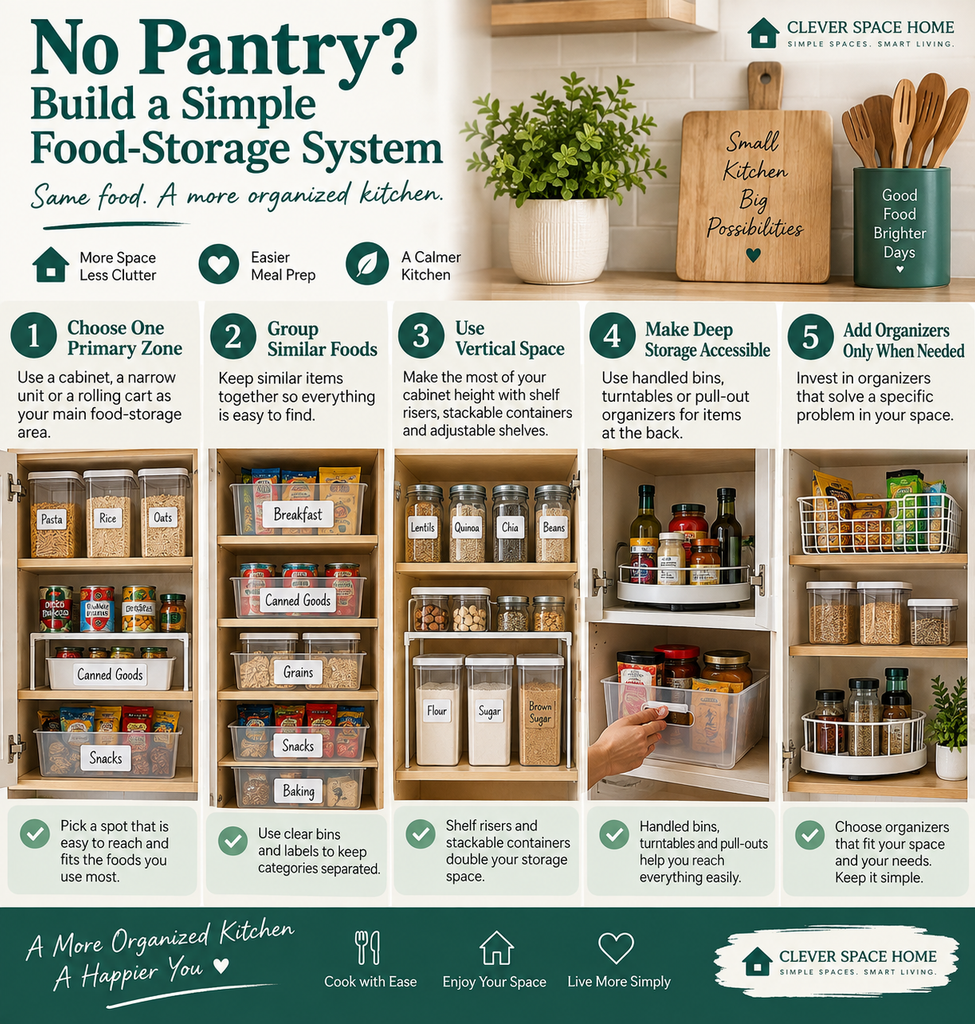
Step 2: Choose One Primary Food-Storage Zone
When there is no pantry, the most important decision is where most shelf-stable food will live. Instead of spreading food across every available cabinet, try to establish one primary storage zone and use secondary areas only when necessary.
A kitchen cabinet can work well as the main pantry zone, particularly if it is easy to reach and large enough for the foods you use regularly. For shelf-stable foods, choose a cool, clean, dry storage area away from extreme heat or cold. If cabinet space is extremely limited, a freestanding shelving unit, narrow storage cabinet, rolling cart, or another suitable storage area may provide additional capacity without taking over the kitchen.
Keep convenience in mind when choosing the location. Frequently used foods should generally be easy to reach during meal preparation, while unopened backups and less frequently used ingredients can occupy less accessible storage.
If you are using existing cabinets as your main food-storage area, our guide on how to organize kitchen cabinets in a small kitchen explains how to create practical zones and make better use of cabinet height and depth.
Step 3: Create Simple Food Categories
Once you have chosen the main storage area, divide foods into categories that match the way you shop and cook. Common groups might include breakfast foods, canned goods, grains and pasta, baking supplies, snacks, spices, sauces, and unopened backups.
Avoid creating so many categories that maintaining the system becomes difficult. If you only have a few items of one type, they may not need their own dedicated container or shelf. The purpose of categories is to make food easier to find, not to create a complicated filing system.
Place categories you use frequently in the most accessible areas. Items used less often can usually go higher, lower, or farther back, provided you can still see and retrieve them without unloading an entire shelf.
Step 4: Use Vertical Space Without Making Food Hard to Reach
Tall cabinets often contain unused space above shorter cans, jars, boxes, and containers. Shelf risers can create another usable level, while adjustable shelves can help reduce large gaps between stored items when the cabinet design allows them.
Stacking can also save space, but only when the items are stable and the labels remain reasonably easy to identify. Avoid building tall stacks that need to be dismantled whenever you want something from the bottom.
Measure the available width, depth, and height before buying shelf risers or other organizers. An organizer should make the space easier to use; it should not simply fill an empty area or create another obstacle between you and your food.
Step 5: Make Deep Shelves and Cabinets Easier to Access
Deep storage can be useful in a kitchen without a pantry, but food placed at the back can easily become forgotten. Try to arrange deep shelves so that you can identify what is behind the front row without moving several unrelated products.
Handled bins can help group similar foods and allow an entire category to be pulled forward. Turntables can work well for certain jars, bottles, and condiments when they can rotate freely, while pull-out organizers may be useful in cabinets with suitable dimensions and clearance.
Another simple approach is to keep everyday foods toward the front and clearly grouped backup supplies toward the back. Whatever system you choose, avoid allowing older products to disappear behind newer purchases.
Step 6: Decide When Containers Are Actually Useful
Matching containers can make a pantry area look organized, but transferring every packaged food into a new container is not necessary. Containers are most useful when they solve a practical problem, such as keeping frequently used dry ingredients together, making bulky packaging easier to store, or protecting foods that require an appropriate sealed container after opening.
Clear containers can make contents easier to identify, while labels may be useful when different ingredients look similar or when storage instructions, expiration information, or preparation details need to remain available.
If you transfer food out of its original packaging, retain any important information you may need later, including relevant storage or preparation instructions. Choose containers that are intended for food storage and appropriate for the particular food being stored.
Recommended Product: Chirons Pantry Bamboo Bread Box
Containers are most useful when they solve a specific storage problem rather than simply transferring food from one container to another. Bread is a good example because loaves, rolls, and similar items can quickly occupy valuable counter or cabinet space when they do not have a defined storage location.
A dedicated bread box creates one place for these items while helping the rest of the food-storage area remain organized. The clear viewing window also makes it easier to see what is stored inside without repeatedly opening the box. Before buying, measure the intended counter or shelf space so the bread box does not create additional clutter.
Check the Chirons Pantry Bamboo Bread Box on Amazon → (paid link)
Step 7: Use Doors, Walls, and Freestanding Storage Carefully
When cabinets are limited, other parts of the kitchen may provide useful storage. The inside of a suitable cabinet door can sometimes hold lightweight items, while wall-mounted storage may work for certain kitchen supplies if it can be installed safely and does not interfere with normal kitchen use.
A narrow freestanding cabinet or rolling cart can also create pantry-style storage where the kitchen layout allows it. These solutions are most valuable when they provide a predictable home for food rather than becoming another place where miscellaneous items accumulate.
Recommended Product: Function Home Tall Narrow Freestanding Storage Cabinet
When a kitchen has no built-in pantry, a narrow freestanding cabinet can create a dedicated food-storage zone without requiring a large amount of floor space. Using vertical space can be particularly useful in a small kitchen where adding wider furniture would interfere with movement.
An enclosed cabinet also keeps stored items visually contained instead of leaving every package on display. Before choosing one, measure the available floor area, cabinet height, nearby doors, and walking clearance carefully. A storage cabinet should improve the kitchen’s function without making the room harder to move through.
Check the Function Home Tall Narrow Storage Cabinet on Amazon → (paid link)
Before adding storage to a door, wall, or narrow gap, measure carefully and consider clearance. Make sure doors can still open fully, walkways remain usable, and anything mounted or freestanding is suitable for the weight it will carry.
Step 8: Keep Counters From Becoming the Pantry
When storage is limited, kitchen counters can gradually become permanent holding areas for bread, snacks, cereal boxes, produce, appliances, and unopened groceries. Keeping everything visible may seem convenient, but too many items can reduce valuable preparation space and make a small kitchen feel more crowded.
Reserve countertop storage for items that genuinely benefit from being there. Frequently used foods or a small basket of appropriate items may make sense, but products that are rarely used should generally have another designated home.
When something repeatedly ends up on the counter because there is nowhere else to put it, treat that as a sign that the storage system needs adjusting rather than automatically adding another countertop organizer.
Recommended Product: ElegantArray 8-Tier Over-the-Door Pantry Organizer
A suitable door can provide substantial vertical storage when there is no traditional pantry. A full-height over-the-door organizer creates multiple levels for packaged foods and other pantry items while using space that might otherwise remain unused.
This approach works best when the door has adequate clearance and the stored items can be distributed safely without making the door difficult to operate. Check the organizer’s dimensions, door compatibility, and available clearance before purchasing.
Check the ElegantArray 8-Tier Over-the-Door Pantry Organizer on Amazon → (paid link)
Best Storage Organizers for a Kitchen Without a Pantry
You do not need every type of pantry organizer. Start by identifying the particular problem you need to solve—unused height, excessive depth, scattered small items, awkward corners, or insufficient cabinet capacity—and choose a solution accordingly.
Shelf Risers
Shelf risers can create an additional storage level for shorter cans, jars, containers, or packaged foods. They are most useful when there is substantial unused vertical space between the items and the shelf above.
Turntables
Turntables can improve access to jars, bottles, condiments, and other relatively small items stored in deep or awkward areas. Measure the space first and make sure the turntable can rotate without hitting the cabinet walls or surrounding products.
Bins and Baskets
Bins can keep categories such as snacks, baking supplies, or packaged foods together. Handled bins are particularly useful on deeper shelves because they can be pulled forward, but oversized containers may waste space and hide their contents.
Airtight Food-Storage Containers
Suitable airtight containers can be useful for foods that benefit from sealed storage after opening. Choose sizes based on the foods you actually buy rather than purchasing a large matching set simply for appearance.
Rolling Carts or Narrow Storage Units
A compact rolling cart or narrow storage unit can provide additional capacity when cabinet space is insufficient. Before buying one, measure both the available floor space and nearby walkways so that additional storage does not make a small kitchen harder to move around.
Common Mistakes When Organizing a Kitchen Without a Pantry
One common mistake is purchasing containers and organizers before deciding where food will actually be stored. Even attractive storage products can create more clutter if they do not fit the available space or solve a specific problem.
Another mistake is spreading the same category across too many locations. When snacks, canned foods, or baking ingredients are stored in several unrelated cabinets, it becomes harder to know what you already have. Keep categories together where practical.
Avoid overfilling bins simply because additional items can physically fit inside them. A storage system should allow you to see and retrieve food without repeatedly emptying containers or moving large stacks.
Finally, do not sacrifice too much preparation or walking space in an attempt to recreate a full-size pantry. In a genuinely small kitchen, a smaller, well-managed food inventory may work better than adding storage to every available surface.
How to Organize a Small Kitchen Without a Pantry and Keep It That Way
Once each food category has a predictable home, return items to that location after shopping and cooking. This simple habit is more important than maintaining a perfectly styled pantry.
When bringing home groceries, place newer items behind older comparable products when appropriate so existing food remains visible and is more likely to be used first. Periodically check for expired products, nearly empty packages, duplicates, and foods that are no longer being used.
If one area repeatedly becomes overcrowded, reconsider what is stored there before buying another organizer. You may need to reduce the amount kept on hand, move a less frequently used category elsewhere, or give more accessible space to the foods your household actually uses most often.
Final Thoughts
Learning how to organize a small kitchen without a pantry is less about recreating a traditional pantry and more about building a simple food-storage system around the space you already have. Choose a primary storage zone, group foods logically, make careful use of vertical and deep storage, and add organizers only when they solve a genuine accessibility or space problem.
The best system will depend on your kitchen layout, shopping habits, and the foods you regularly keep at home. Keep the arrangement simple enough to maintain, measure before purchasing storage products, and adjust the system as your needs change.
8 thoughts on “How to Organize a Small Kitchen Without a Pantry”
Comments are closed.