
Disclosure: This post contains affiliate links. If you purchase through these links, we may earn a commission at no additional cost to you.
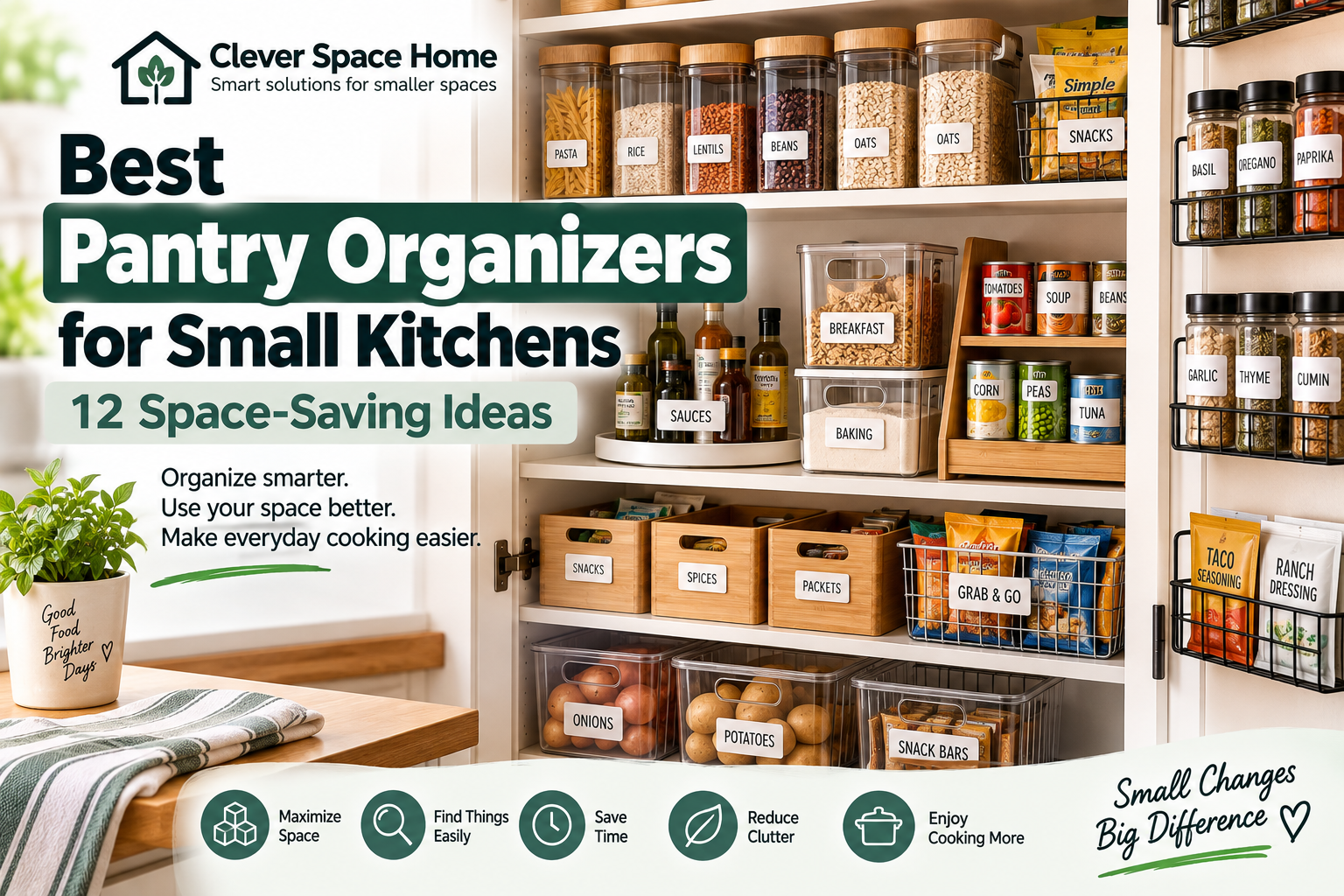
A small kitchen pantry can become cluttered surprisingly quickly. Cans get pushed behind boxes, snack packets disappear onto crowded shelves, and half-used ingredients are easily forgotten.
The problem is usually not simply having too many groceries. Limited shelf space, deep cabinets, awkward corners, and poor visibility can make even a modest amount of food difficult to organize.
The best pantry organizers for small kitchens help make existing storage easier to see and use. Instead of filling every available inch, a good organization system creates practical zones, improves access, and makes it easier to know what you already have.
You also do not need a traditional walk-in pantry. These ideas can work in pantry cabinets, freestanding cupboards, kitchen cabinets, shelving units, or other compact food-storage areas.
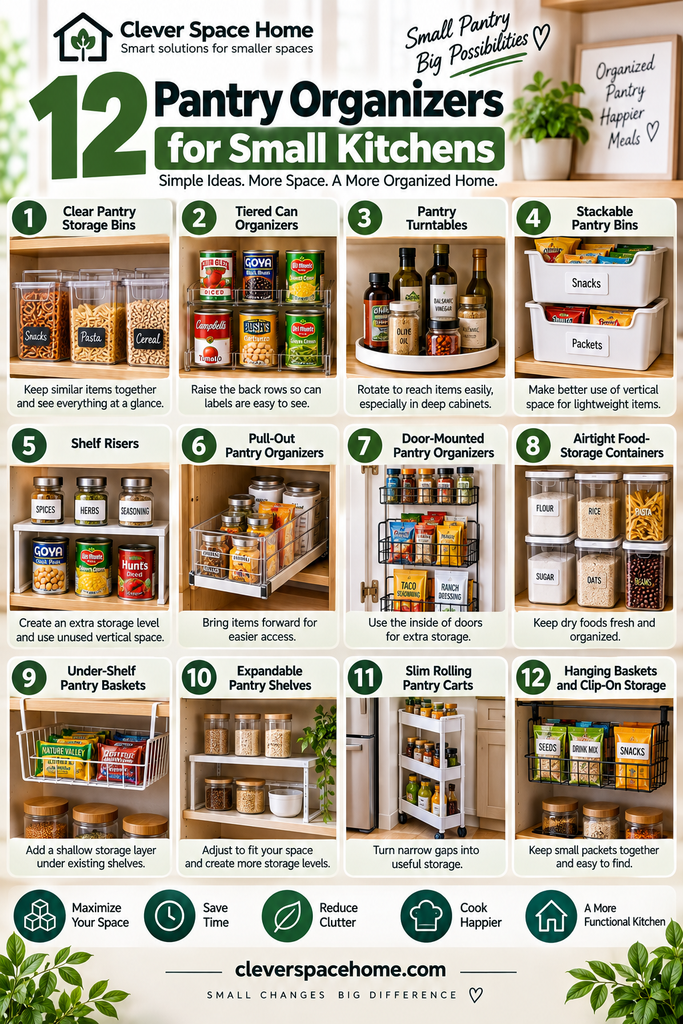
Below are 12 practical pantry organizer ideas for making better use of limited kitchen space.
Table of Contents
Before Choosing Pantry Organizers, Measure Your Space
Start by measuring the width, depth, and height of the shelves you want to organize.
This is particularly important in a small kitchen because an organizer that is only slightly too large can waste valuable storage space instead of improving it.
Measure the usable space between shelves rather than relying only on the overall dimensions of the cabinet.
Also look at what you actually store.
A household with many canned foods may benefit from tiered organizers, while someone who buys packets, snacks, and baking ingredients may get more value from bins and baskets.
If your food storage is spread across ordinary kitchen cabinets, our guide on how to organize kitchen cabinets in a small kitchen can help you establish practical storage zones before adding organizers.
The goal is to choose organizers that solve specific storage problems rather than buying containers simply because they look attractive.
1. Clear Pantry Storage Bins
Clear storage bins are among the most versatile pantry organizers for small kitchens.
They can group similar items together while allowing you to see what is inside without pulling everything off the shelf.
Consider separate bins for categories such as:
- Snacks
- Breakfast foods
- Baking supplies
- Pasta and grains
- Sauces and packets
Bins can be particularly useful on deep shelves because an entire category can be pulled forward at once.
Avoid choosing unnecessarily large bins. Several appropriately sized containers often provide more flexibility than one oversized basket.
Recommended Product: Vtopmart Clear Pantry Storage Bins with Handles
For pantry shelves where visibility matters, these clear Vtopmart storage bins make it easier to group packaged foods, snacks, baking supplies, and other everyday items without hiding what is inside. Built-in handles also make the bins easier to pull forward from deeper shelves.
They work particularly well for creating separate pantry zones while keeping frequently used foods easy to see and reach.
Check the Vtopmart Clear Pantry Storage Bins on Amazon → (paid link)
2. Tiered Can Organizers
Canned foods can waste space when they are arranged in several rows at the same height.
A tiered organizer raises the back rows so labels remain visible.
This can make it easier to spot beans, soups, vegetables, sauces, and other canned ingredients without moving the cans at the front.
Tiered designs work especially well when shelf width is available but visibility is poor.
Before buying one, measure the vertical clearance above your cans to ensure the raised levels will fit comfortably beneath the shelf above.
Recommended Product: Yecuip Expandable 3-Tier Can Organizer
For canned foods, a tiered organizer can make much better use of vertical pantry space while keeping cans visible instead of stacking them behind one another. This Yecuip organizer uses three levels and an expandable design, making it easier to adapt the setup to the available shelf width.
It is particularly useful for small pantries where several cans need to fit within a limited footprint without becoming difficult to access.
Check the Yecuip Expandable 3-Tier Can Organizer on Amazon → (paid link)
3. Pantry Turntables
A turntable, sometimes called a lazy Susan, can make awkward pantry corners much easier to use.
Instead of reaching behind several products, rotate the organizer until the item you need comes to the front.
Turntables can work well for:
- Sauces
- Oils
- Condiments
- Small jars
- Spreads
- Baking ingredients
They are especially useful in deep cabinets where small items otherwise become hidden.
However, round organizers naturally leave some unused space around their edges, so they are better for accessibility than for maximizing every square inch.
Recommended Product: Guzon 4-Pack Lazy Susan Turntable Organizer
A rotating organizer can make bottles, jars, condiments, and other pantry staples easier to reach, especially toward the back of a shelf. The raised sides help keep items contained while the turntable allows you to rotate the contents instead of moving several products to reach one item.
The four-piece set can also be divided between different pantry shelves or other kitchen storage areas rather than requiring everything to be stored together.
Check the Guzon Lazy Susan Turntable Organizer on Amazon → (paid link)
4. Stackable Pantry Bins
Vertical space is often underused in small pantries.
Stackable bins can create additional storage levels without requiring permanent shelving changes.
They can work particularly well for lightweight packaged foods such as snack bags, packets, bread products, and individually wrapped items.
Choose designs that remain accessible after stacking. Open-front bins can be more practical than containers that require removing the upper bin every time you need something underneath.
Do not stack containers so high that they become unstable or inconvenient to use.
5. Shelf Risers
Shelf risers create an additional level inside a pantry shelf or cabinet.
For example, jars or cans can sit underneath the riser while shorter containers or packaged foods sit above it.
This can help make better use of tall shelf openings where a large amount of vertical space would otherwise remain empty.
Shelf risers are particularly useful when you cannot adjust the existing pantry shelves.
For a broader look at this type of vertical storage, see our guide to the best cabinet organizers for small kitchens.
6. Pull-Out Pantry Organizers
Deep pantry shelves can hold plenty of food but still be frustrating because items at the back are difficult to reach.
Pull-out organizers solve this problem by bringing stored items forward.
They can be useful for:
- Canned foods
- Bottles
- Packets
- Baking ingredients
- Small jars
Some systems sit directly on existing shelves, while others require installation.
For renters or anyone who prefers not to modify cabinetry, freestanding sliding bins may be the simpler option.
Always check the available depth and any cabinet-door hinges before choosing a pull-out system.
Recommended Product: Halyuhn 2-Pack Pull-Out Cabinet Organizer
A pull-out organizer can improve access to items stored toward the back of a pantry or cabinet. Instead of reaching past products at the front, the sliding basket brings stored items forward so they are easier to see and retrieve.
This style is particularly useful on deeper shelves where smaller bottles, packets, jars, or pantry supplies tend to disappear behind other items.
Check the Halyuhn Pull-Out Cabinet Organizer on Amazon → (paid link)
7. Door-Mounted Pantry Organizers
The inside of a pantry or cabinet door can provide useful storage that is easy to overlook.
A door-mounted organizer can hold smaller or lighter items such as seasoning packets, snack bars, wraps, small jars, or other frequently used foods.
This can free shelf space for larger containers.
Before installing one, check that the door has enough clearance to close when the shelves inside the cabinet are full.
Heavy items should generally remain on stronger pantry shelves rather than being placed on a lightweight door organizer.
8. Airtight Food-Storage Containers
Dry foods often come in bags and boxes that use more shelf space than necessary.
Airtight containers can create a more uniform storage system for foods such as:
- Rice
- Pasta
- Flour
- Sugar
- Oats
- Cereal
- Dried beans
Square or rectangular containers typically use shelf space more efficiently than round containers because they can sit closely together.
However, there is no reason to transfer every grocery item into a matching container.
Use them where they genuinely improve storage, freshness, visibility, or everyday access.
Recommended Product: Vtopmart Airtight Food Storage Containers with Lids
Airtight containers can help consolidate dry pantry staples such as flour, sugar, cereal, pasta, rice, and baking ingredients into more uniform storage. Their clear construction also makes it easier to check contents without repeatedly opening containers.
Using matching containers can make better use of shelf space, but container sizes should still be chosen according to the foods you actually store rather than transferring every pantry item simply for appearance.
Check the Vtopmart Airtight Food Storage Containers on Amazon → (paid link)
9. Under-Shelf Pantry Baskets
The area immediately beneath a shelf can sometimes be turned into additional storage.
Under-shelf baskets attach or slide onto an existing shelf and create a shallow storage layer underneath it.
They can be useful for lightweight items such as packets, wraps, small snack bags, or kitchen linens.
This type of organizer is especially useful when pantry shelves have large gaps between them.
Check the thickness of your existing shelf and the basket’s attachment design before buying one.
Our broader guide to the best kitchen organizers for small kitchens includes additional ways to use overlooked vertical space.
10. Expandable Pantry Shelves
Not every pantry or cabinet has the same dimensions.
Expandable shelf organizers can be adjusted to better fit the available width, making them useful when fixed-size organizers leave awkward gaps.
Depending on the design, they can create an additional shelf or provide multiple storage levels.
They work particularly well when your food-storage setup may change over time.
Measure both the minimum and maximum width of the organizer before buying so you know its adjustment range works for your space.
11. Slim Rolling Pantry Carts
Some kitchens have a narrow unused gap beside a refrigerator, cabinet, or wall.
A slim rolling cart can potentially turn this otherwise wasted area into food storage.
Depending on its width and construction, it may hold:
- Cans
- Bottles
- Snacks
- Packaged foods
- Baking supplies
Measure the gap carefully, including baseboards and any handles that may reduce usable space.
The cart should also be easy to pull out without blocking a major walkway.
For kitchens without a dedicated pantry, our guide on how to organize a small kitchen without a pantry covers additional ways to create food-storage zones throughout the room.
Recommended Product: SUNALLY Slim Rolling Storage Cart
When a small kitchen has a narrow unused gap, a slim rolling cart can turn that space into additional storage. The vertical design provides multiple storage levels while wheels allow the cart to be moved when access is needed.
This type of organizer can work well for pantry goods, bottles, packaged foods, or other lightweight kitchen supplies when conventional cabinet and pantry space is limited.
Check the SUNALLY Slim Rolling Storage Cart on Amazon → (paid link)
12. Hanging Baskets and Clip-On Storage
Small packets are often among the hardest pantry items to organize.
Seasoning packets, drink mixes, small snack bags, and similar items can disappear behind larger containers.
Hanging baskets or clip-on storage can keep these lightweight items together without occupying an entire shelf.
They can attach to suitable shelving, rails, or other pantry surfaces depending on the design.
Use them selectively. Too many hanging accessories can make a small pantry feel more cluttered rather than more organized.
How to Choose the Best Pantry Organizers for Small Kitchens
The best pantry organizers for small kitchens are the ones that solve the problems created by your particular storage space.
Before purchasing anything, consider four factors.
Available Dimensions
Measure first.
An attractive organizer is not useful if it prevents a cabinet door from closing or leaves too little room for the foods you normally buy.
Visibility
In a small pantry, forgotten food wastes both space and money.
Clear bins, tiered organizers, labels, and pull-out storage can improve visibility.
Accessibility
Frequently used foods should be easy to reach.
Reserve difficult corners and higher shelves for items you use less often.
Flexibility
Your grocery habits can change.
Adjustable, stackable, or modular organizers often adapt better than highly specialized storage systems.
Create Pantry Zones Before Buying More Organizers
Organization becomes easier when similar foods have consistent locations.
You might create zones for:
- Breakfast: cereal, oats, spreads and coffee supplies.
- Cooking staples: rice, pasta, grains and canned foods.
- Baking: flour, sugar, baking powder and decorations.
- Snacks: crackers, bars and individually packaged foods.
- Sauces and condiments: bottles, jars and dressings.
The exact categories matter less than keeping the system understandable.
When everyone in the household knows where an item belongs, the pantry is easier to maintain.
Keep Frequently Used Foods at Eye Level
Prime pantry space should generally be reserved for foods you use most often.
Everyday ingredients can stay around eye level or within comfortable reach.
Less frequently used supplies can occupy higher or lower shelves.
This reduces the amount of searching and rearranging required during everyday cooking.
It also helps prevent frequently used foods from being pushed behind less important items.
Avoid Overfilling Pantry Bins
Storage bins can improve organization, but they can also hide clutter if they are packed too tightly.
Leave enough room to remove items without emptying the entire container.
If one category continually overflows its bin, either reconsider the size of the bin or review how much of that food you normally keep.
An organized pantry should make food easier to access, not simply compress more products into the same space.
Use Labels Only Where They Help
Labels can make categories easier to maintain, especially when several similar bins are used.
But every container does not need a decorative label.
Simple labels such as “Snacks,” “Baking,” or “Breakfast” may be enough.
If a clear container already makes its contents obvious, a label may add little practical value.
Function should come before appearance.
Keep Food Storage Safe
Organization should never interfere with proper food storage.
Keep dry pantry foods in a cool, dry area and follow manufacturer instructions for products that require refrigeration after opening.
Check packaging regularly for damage, leaks, moisture, or signs of pests.
The USDA Food Safety and Inspection Service provides additional guidance on safe food handling and storage practices.
Check Expiration and Best-Quality Dates Regularly
A pantry organizer cannot solve the problem of keeping food you no longer intend to use.
Periodically review your pantry.
Move older foods toward the front when appropriate and newer purchases behind them.
This simple rotation can improve visibility and reduce forgotten items.
Avoid buying replacements simply because you cannot see what is already stored at the back of a shelf.
Do Not Buy Every Organizer at Once
It can be tempting to redesign an entire pantry in one shopping session.
A better approach is to fix the biggest storage problem first.
For example, if cans are difficult to see, begin with a tiered organizer. If deep shelves are the problem, try pull-out bins. If snack packets are creating clutter, introduce one dedicated bin.
Use the system for a while before deciding what else is necessary.
This gradual approach reduces unnecessary purchases and makes it easier to discover which organizers actually improve your kitchen.
Frequently Asked Questions
What is the best way to organize a small pantry?
Start by grouping similar foods into zones, keeping frequently used items within easy reach, and using organizers only where they solve specific problems. Clear bins, tiered shelves, turntables, and pull-out storage can improve visibility and access.
Are clear pantry containers worth using?
They can be useful when they improve visibility, make awkward packaging easier to store, or help keep dry foods protected. You do not need to transfer every food item into a matching container.
How do I organize a pantry with deep shelves?
Use pull-out bins, baskets, or turntables to make items at the back easier to reach. Grouping similar products in removable bins can also prevent food from disappearing behind other items.
How can I create pantry storage if I do not have a pantry?
Use available kitchen cabinets, freestanding shelving, rolling carts, or other suitable storage areas to create dedicated food zones. Keeping related foods together is more important than having a traditional pantry.
Should pantry containers be square or round?
Square and rectangular containers generally make more efficient use of shelf space because they fit closely together. Round containers can still work well for specific foods or on turntables.
How do I keep a small pantry organized?
Avoid overfilling it, return foods to consistent zones, review expired or unused items periodically, and adjust your organization system when your shopping habits change.
Final Thoughts
The best pantry organizers for small kitchens are not necessarily the systems that hold the greatest number of products.
They are the ones that make limited storage easier to see, reach, and maintain.
Clear bins can group similar foods, tiered organizers improve visibility, pull-out systems make deep shelves more accessible, and shelf risers can take advantage of unused vertical space.
Start with the area that causes the most frustration and improve it first.
A small pantry—or even a few cabinets used as a pantry—can work efficiently when every organizer has a clear purpose.
5 thoughts on “Best Pantry Organizers for Small Kitchens: 12 Space-Saving Ideas”
Comments are closed.