
Disclosure: This post contains affiliate links. If you purchase through these links, we may earn a commission at no additional cost to you.
A small kitchen can work surprisingly well when every storage area has a clear purpose. The challenge is rarely just the amount of space available. More often, useful space is hidden inside deep cabinets, above shelves, behind doors, on empty walls, or underneath existing storage areas.
The best small kitchen storage ideas focus on using these overlooked spaces while keeping frequently used items easy to reach. Instead of filling the kitchen with more containers and organizers, the goal should be to create a practical storage system that fits the way you actually cook, clean, and use the room.
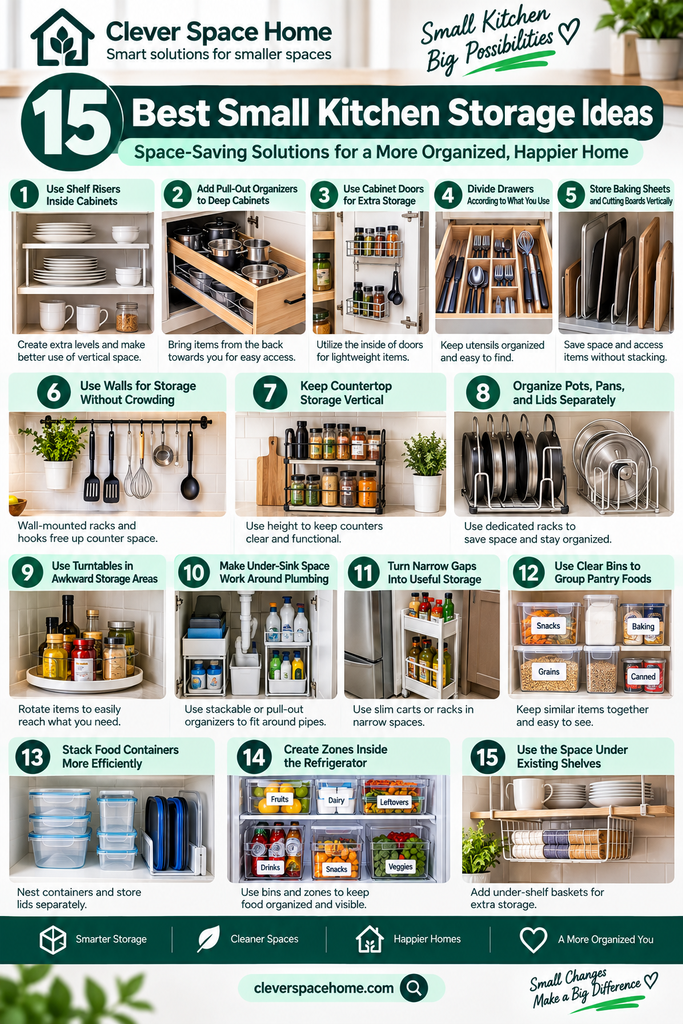
From cabinets and drawers to refrigerator shelves and narrow gaps, the following 15 ideas can help you make better use of a small kitchen without making it feel crowded.
Table of Contents
Before Adding Storage, Decide What Actually Needs Space
Before buying organizers or rearranging cabinets, take a quick inventory of what you keep in the kitchen.
Remove items you rarely use, duplicates you do not need, damaged containers, expired food, and appliances that take up more space than their usefulness justifies.
Then group what remains into practical categories such as cookware, food storage, baking supplies, utensils, cleaning products, pantry foods, and everyday dishes.
This makes it easier to see where storage is actually needed.
A useful small-kitchen rule is simple: frequently used items should be easiest to reach, while occasional-use items can occupy higher, deeper, or less convenient storage areas.
If your cabinets are the biggest challenge, our guide on how to organize kitchen cabinets in a small kitchen explains how to divide cabinet space into practical zones.
1. Use Shelf Risers Inside Cabinets
Kitchen cabinets often have unused vertical space between one shelf and the next.
Shelf risers create an additional level so bowls, plates, mugs, canned foods, or pantry items can be stored without stacking everything directly on top of each other.
This is especially useful in cabinets with tall shelf openings.
Instead of creating one unstable stack, a riser can separate items into two accessible levels.
Choose a riser that fits the cabinet depth and leaves enough clearance for the items you plan to store underneath it.
Recommended Product: Expandable 2-Tier Stackable Cabinet Shelf Organizer
When cabinet shelves leave a lot of unused vertical space, an expandable shelf organizer can create an additional storage level without requiring permanent changes to the cabinet. This adjustable two-tier design can help separate dishes, bowls, mugs, pantry items, or other frequently used kitchen essentials.
The expandable design is particularly useful in a small kitchen because you can adjust the organizer to suit the available cabinet width rather than giving up unnecessary shelf space.
Check the Expandable 2-Tier Cabinet Shelf Organizer on Amazon → (paid link)
2. Add Pull-Out Organizers to Deep Cabinets
Deep cabinets can hold plenty of items, but the space at the back often becomes difficult to use.
Pull-out organizers allow stored items to slide toward you instead of requiring you to reach past everything in front.
They can work particularly well for pots, pans, food containers, cleaning products, pantry foods, and small appliances.
Before installing one, measure the cabinet opening as well as the interior width, depth, and height. Hinges, plumbing, and door frames can reduce the usable space.
For more cabinet-specific options, see our guide to the best cabinet organizers for small kitchens.
ecommended Product: PAKETA 4-Pack Expandable Pull-Out Cabinet Organizer
Deep cabinets can make items at the back difficult to reach. This expandable pull-out organizer creates a sliding storage area, allowing cookware, pantry supplies, containers, and other frequently used items to be pulled forward instead of digging through the cabinet.
Its adjustable design can also make it easier to fit different cabinet widths. Before ordering, measure the usable interior width and depth of your cabinet and check for hinges, door frames, pipes, or other obstructions that could interfere with installation.
Check the PAKETA Pull-Out Cabinet Organizer on Amazon → (paid link)
3. Use Cabinet Doors for Extra Storage
The inside of a cabinet door is often completely unused.
Depending on the cabinet, this space can hold lightweight racks, small baskets, lid holders, measuring tools, wraps, cleaning accessories, or other slim items.
Door-mounted storage is particularly useful when shelf space is limited.
However, avoid adding heavy objects that could strain hinges or prevent the cabinet door from closing correctly.
Always check the clearance between the door organizer and the shelves inside the cabinet before installation.
Recommended Product: YMCCOOL 2-Pack Cabinet Door Organizer
The inside of a cabinet door can provide useful storage without taking up another shelf. This YMCCOOL organizer is designed to hold flat kitchen items such as cutting boards and similar essentials vertically, helping keep them separated and easier to retrieve.
Using cabinet-door space can be especially helpful in a small kitchen where shelf and countertop space are already limited. Just check the available clearance before installation so the organizer does not interfere with items stored inside the cabinet.
Check the YMCCOOL Cabinet Door Organizer on Amazon → (paid link)
4. Divide Drawers According to What You Use
A drawer without divisions can quickly become a pile of utensils.
Expandable trays, modular bins, and adjustable dividers help create defined spaces for cutlery, cooking utensils, measuring tools, food-storage accessories, and other small kitchen items.
The goal is not to create dozens of tiny compartments. Instead, divide the drawer according to the categories you actually use.
Frequently used utensils should remain easiest to reach.
Our guide to the best drawer organizers for small kitchens covers additional ways to organize shallow and deep kitchen drawers.
5. Store Baking Sheets and Cutting Boards Vertically
Baking sheets, cutting boards, serving trays, and muffin tins are often stacked horizontally.
That saves some space, but retrieving the bottom item usually means moving everything above it.
Vertical dividers allow these flat kitchen items to stand upright, similar to files.
This can make better use of narrow cabinet sections while allowing individual items to be removed without disturbing the rest.
Before adding dividers, measure the tallest item and make sure the cabinet provides enough vertical clearance.
Recommended Product: Housolution Expandable Cutting Board Organizer Rack
Baking sheets, cutting boards, and trays can become difficult to access when they are stacked on top of one another. This expandable organizer uses adjustable dividers to keep flat kitchen items stored vertically, making it easier to remove one item without shifting the rest of the stack.
The adjustable layout also allows the spacing between dividers to be changed for different types of bakeware and cutting boards. Before choosing a setup, measure the available cabinet width, depth, and height to make sure your largest items can stand securely without interfering with the cabinet door or shelf above.
Check the Housolution Cutting Board Organizer Rack on Amazon → (paid link)
6. Use Walls for Storage Without Crowding the Counter
Small kitchens often have limited cabinets but unused wall space.
Wall-mounted rails, hooks, shelves, magnetic holders, or racks can move suitable items away from crowded counters and drawers.
Depending on your kitchen, wall storage might work for utensils, lightweight cookware, towels, spices, or frequently used tools.
Keep wall storage selective rather than covering every available surface.
Too many exposed items can make a small room feel visually crowded even when they technically create additional storage.
Recommended Product: PUSDON Wall-Mounted Hanging Storage Organizer
Available wall space can provide additional kitchen storage without occupying valuable countertop or cabinet space. This PUSDON wall-mounted organizer combines shelf storage with hanging hooks, allowing different kitchen essentials to be kept together while remaining accessible.
A wall-mounted system can work particularly well for frequently used items that would otherwise accumulate on the counter. Placement matters, however, so install it where stored items can be reached comfortably without interfering with cooking or preparation areas.
Check the PUSDON Wall-Mounted Storage Organizer on Amazon → (paid link)
7. Keep Countertop Storage Vertical
When some items must remain on the counter, vertical storage can reduce the amount of work surface they occupy.
Tiered organizers, compact shelves, corner racks, and vertical holders can use height rather than spreading items across the countertop.
This works well for frequently used cooking supplies, coffee accessories, produce, cutting boards, or small containers.
Countertop storage should still leave enough clear workspace for food preparation.
For more options, see our guide to the best countertop organizers for small kitchens.
8. Organize Pots, Pans, and Lids Separately
Cookware can consume a large portion of a small kitchen’s cabinet space.
Instead of placing every pot, pan, and lid into one stack, consider separating the different components.
Pans may fit into a vertical or adjustable rack, while lids can be stored in a dedicated holder or narrow cabinet section.
Nesting compatible cookware can also reduce wasted space.
Avoid forcing coated cookware into tight stacks if doing so may scratch or damage the surfaces.
For a complete cookware-storage system, read how to organize pots and pans in a small kitchen.
9. Use Turntables in Awkward Storage Areas
Corners and deep shelves can make small items difficult to see.
A turntable can bring items from the back toward the front with a simple rotation.
They can be useful for condiments, oils, sauces, jars, spices, cleaning supplies, and certain refrigerator items.
Choose a turntable based on the usable shelf dimensions rather than the advertised overall size alone.
Also check the height of the products you intend to store so they can rotate without hitting the shelf above.
Recommended Product: OVICAR Wooden Lazy Susan Turntable Organizer
Awkward cabinet corners and deep shelves can make bottles, jars, and condiments difficult to reach. This wooden Lazy Susan rotates 360 degrees, allowing items at the back to be brought forward without having to move everything stored in front of them.
Its raised rim helps keep bottles and containers in place while rotating, while the compact round design works well for spices, oils, sauces, and other frequently used kitchen essentials. Before ordering, measure the available cabinet or shelf space to make sure the turntable can rotate freely without hitting the cabinet walls or door.
Check the OVICAR Wooden Lazy Susan Turntable Organizer on Amazon → (paid link)
10. Make Under-Sink Space Work Around Plumbing
The cabinet beneath the kitchen sink can provide valuable storage, but pipes, drains, garbage disposals, and water lines often divide the available space.
Instead of treating the cabinet as one large area, create smaller storage zones around these obstacles.
Pull-out drawers, narrow bins, door-mounted storage, and stackable organizers may help depending on the plumbing layout.
Avoid blocking shutoff valves or hiding areas that should remain accessible for leak checks.
Our detailed guide to the best under-sink organizers for small kitchens covers organizer types designed for this challenging space.
11. Turn Narrow Gaps Into Useful Storage
Some small kitchens contain narrow spaces beside refrigerators, cabinets, or other fixtures.
When sufficient clearance exists, these gaps may accommodate a slim rolling cart or narrow storage rack.
They can be useful for items such as pantry foods, bottles, wraps, cleaning supplies, or other compact products.
Measure carefully before purchasing anything for a narrow gap.
Also make sure a rolling unit can be removed easily and does not obstruct ventilation, appliance doors, or required clearances.
Recommended Product: SUNALLY Slim Rolling Storage Cart
Narrow gaps beside a refrigerator, cabinet, or wall can become useful storage instead of wasted space. This slim five-tier rolling cart provides vertical storage for pantry items, bottles, kitchen supplies, and other everyday essentials while keeping the overall footprint relatively narrow.
The pull-out baskets make stored items easier to reach, while the wheels allow the cart to move in and out of its storage position when needed. Before ordering, carefully measure the width, depth, and height of the available gap and allow enough clearance for nearby cabinet and appliance doors.
Check the SUNALLY Slim Rolling Storage Cart on Amazon → (paid link)
12. Use Clear Bins to Group Pantry Foods
Small food packages can easily disappear behind one another in cabinets or pantry areas.
Clear storage bins can group similar products while keeping their contents visible.
For example, separate bins might hold snacks, breakfast foods, baking supplies, packets, or canned goods.
Bins are most useful when they create categories rather than simply adding another layer of containers.
If pantry space is your main problem, our guide to the best pantry organizers for small kitchens includes additional ideas for shelves, cans, dry foods, and narrow storage areas.
13. Stack Food Containers More Efficiently
Food-storage containers often occupy more cabinet or drawer space than necessary because containers and lids become mixed together.
Nest compatible containers when possible and store lids separately in a vertical holder, divider, or dedicated bin.
Using fewer container shapes can also make stacking easier.
Avoid keeping containers that are missing lids or lids that no longer match any container.
For more ideas, see our guide to the best food storage organizers for small kitchens.
14. Create Zones Inside the Refrigerator
The refrigerator is another important storage area in a small kitchen.
Instead of placing food wherever space happens to be available, create simple zones for categories such as produce, drinks, condiments, eggs, snacks, and leftovers.
Clear bins, turntables, drawer organizers, and suitable stackable containers can help maintain these zones.
Avoid filling the refrigerator so tightly that air circulation is restricted.
The U.S. Food and Drug Administration recommends keeping refrigerators at 40°F (4°C) or below for safe food storage.
For a detailed fridge setup, see our guide to the best refrigerator organizers for small kitchens.
15. Use the Space Under Existing Shelves
Sometimes the easiest way to gain storage is to use the empty space directly beneath a shelf.
Under-shelf baskets and hanging organizers can create an additional storage layer without permanently changing the cabinet.
They may work for lightweight items such as wraps, small food packages, kitchen linens, or other compact supplies.
Measure both the shelf thickness and the available clearance underneath before choosing an organizer.
Make sure the added basket does not interfere with items stored on the shelf below.
Recommended Product: AmonHouseware 2-Pack Under-Shelf Organizer
The empty area directly beneath a cabinet shelf can sometimes provide useful storage without requiring another cabinet or countertop organizer. This AmonHouseware hanging design creates additional storage underneath an existing shelf, allowing smaller kitchen items to use space that might otherwise remain empty.
This approach works best when there is enough clearance below the organizer for the items already stored underneath. Measure the shelf and surrounding space before choosing the installation position.
Check the AmonHouseware Under-Shelf Organizer on Amazon → (paid link)
How to Combine the Best Small Kitchen Storage Ideas
No single organizer will solve every small-kitchen storage problem.
A more practical approach is to combine several solutions according to the type of space available.
For example, one kitchen might use shelf risers for dishes, vertical dividers for baking sheets, a pull-out organizer beneath the sink, drawer dividers for utensils, and clear bins for pantry foods.
Another kitchen may need completely different solutions.
Our broader guide to the best kitchen organizers for small kitchens can help you compare organizer types across several kitchen storage areas.
Keep Frequently Used Items Close to Where They Are Needed
Storage becomes more efficient when location follows use.
Cooking utensils can stay near the preparation or cooking area. Plates and glasses can remain near the dishwasher or sink. Coffee supplies can stay together near the coffee maker.
This reduces unnecessary movement and makes it easier to return items after use.
Items used only occasionally can be stored in higher cabinets or less convenient areas, leaving prime storage locations for everyday essentials.
Avoid Filling Every Available Space
Maximizing storage does not mean filling every shelf, wall, drawer, and gap.
Leaving some open space makes it easier to see what you own and gives the kitchen room to adapt when groceries or household needs change.
Overfilled organizers can become just as frustrating as unorganized cabinets.
A storage system works best when items can be removed and returned without rearranging several other things.
Measure Before Buying Kitchen Organizers
Measurements are particularly important in small kitchens because even a small sizing mistake can make an organizer unusable.
Measure the width, depth, and height of the actual usable area.
For cabinets, account for hinges and door frames. For drawers, measure the internal dimensions rather than the drawer front. For refrigerators, check shelf spacing and door clearance. For under-sink cabinets, measure around plumbing and other obstacles.
Keep these measurements on your phone so you can compare them with product dimensions before purchasing.
Build Your Small-Kitchen Storage System Gradually
You do not need to reorganize the entire kitchen in one day.
Start with the area causing the most frustration.
That might be an overflowing utensil drawer, a difficult under-sink cabinet, a cluttered countertop, or food containers that never stay organized.
Improve that area first and use it for a while.
Once you know what works, move to the next problem area.
This gradual approach can help prevent buying organizers that look useful but do not actually fit your kitchen or habits.
Frequently Asked Questions
What is the best way to create more storage in a small kitchen?
Start by removing unnecessary items and then use overlooked areas such as vertical cabinet space, cabinet doors, walls, deep shelves, narrow gaps, and the space underneath existing shelves. The best solution depends on the kitchen’s layout and the items you need to store.
How can I organize a small kitchen with very few cabinets?
Prioritize frequently used items inside the available cabinets and consider selective wall storage, vertical countertop storage, slim carts, shelving, and other unused areas. If food storage is the main issue, see our guide on how to organize a small kitchen without a pantry.
Are kitchen organizers worth buying for a small kitchen?
They can be useful when they solve a specific storage problem. Measure first and choose organizers according to the items and space you already have rather than buying containers simply because they look organized.
How do I keep a small kitchen from looking cluttered?
Keep frequently used items accessible while limiting how many objects remain visible on countertops and walls. Group similar items, create defined storage zones, and leave some open space instead of filling every available surface.
Should I organize or declutter first?
Declutter first. Organizing items you no longer need wastes storage space and can lead to purchasing unnecessary organizers. Once unnecessary items are removed, it becomes easier to design storage around what remains.
Final Thoughts
The best small kitchen storage ideas are not necessarily the ones that add the most containers, shelves, or racks. The most effective solutions make existing space easier to use.
Look for wasted vertical space, difficult cabinet corners, unused doors, narrow gaps, crowded drawers, and storage areas that are hard to reach.
Then solve those problems individually.
A few carefully chosen storage solutions can make a small kitchen easier to cook in, easier to clean, and easier to keep organized without making the room feel overcrowded.
7 thoughts on “Best Small Kitchen Storage Ideas: 15 Space-Saving Solutions”
Comments are closed.