
Disclosure: This post contains affiliate links. If you purchase through these links, we may earn a commission at no additional cost to you.
In a small kitchen, drawers can quickly become one of the most frustrating storage areas. Utensils get mixed together, measuring spoons disappear underneath larger tools, food-storage accessories pile up, and valuable drawer space often goes unused.
The right drawer organization system can make a surprisingly big difference. Instead of simply fitting more items into a drawer, good organization makes everyday kitchen tools easier to see, reach, and put away.
This is especially important in a small kitchen, where every drawer needs to work efficiently.
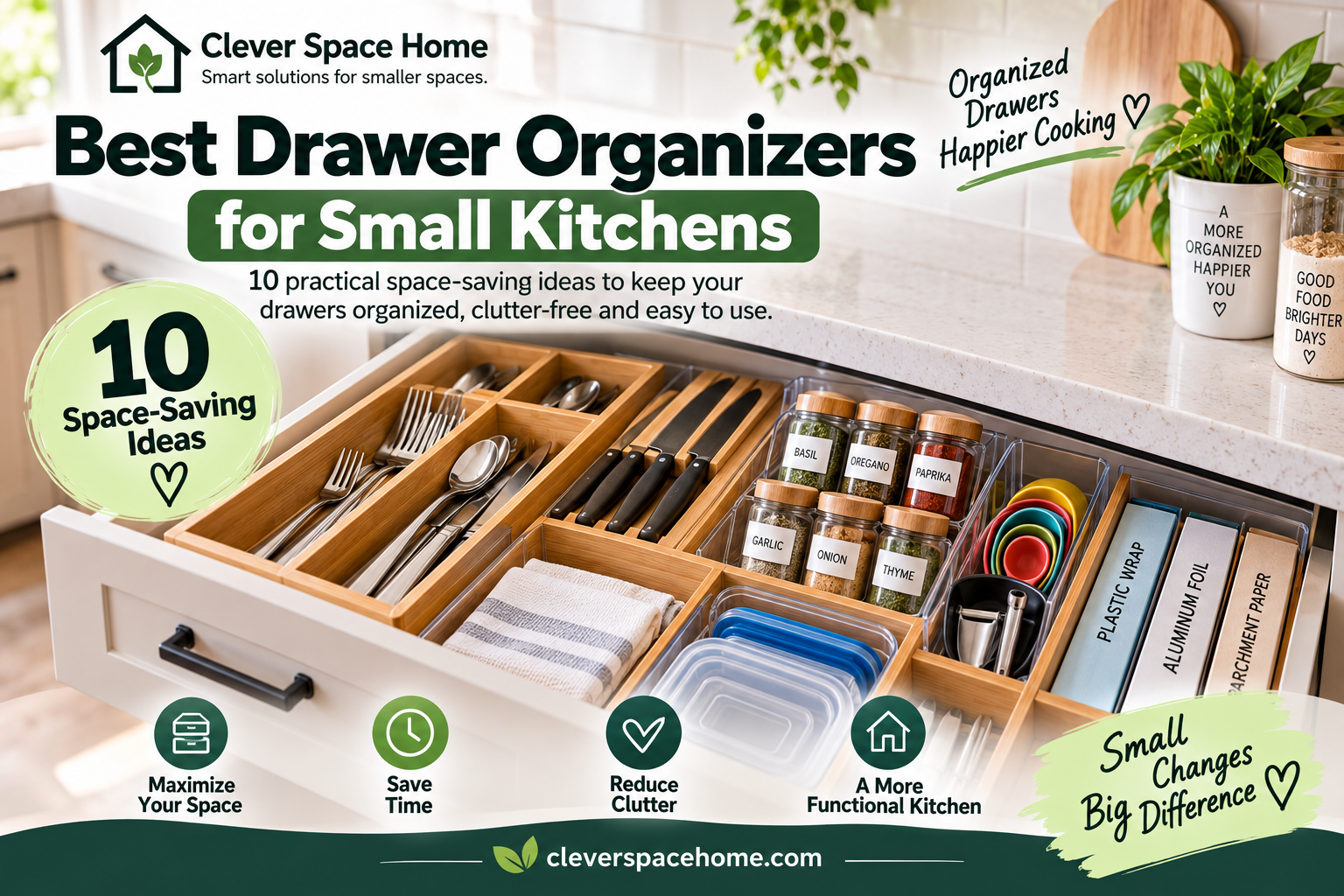
The best drawer organizers for small kitchens use dividers, adjustable compartments, vertical storage, and other space-saving designs to make better use of limited drawer space.
Below are 10 practical drawer organizer ideas that can help reduce clutter and make a small kitchen easier to use.
Table of Contents
Before Buying Drawer Organizers, Measure Your Drawers
Careful measuring is also important when you organize kitchen cabinets in a small kitchen, especially when adding organizers inside existing storage areas. Before choosing any organizer, measure the inside of the drawer rather than relying only on the dimensions of the cabinet.
Measure the drawer’s:
- Interior width
- Interior depth
- Usable height
Pay particular attention to height. Some organizers may technically fit inside the drawer but prevent it from closing once utensils or other items are placed inside.
Also consider what you actually want to store before choosing an organizer. A shallow utensil drawer requires a different solution from a deep drawer used for cooking tools, food-storage containers, or kitchen linens.
Once you know the available dimensions and what needs to be stored, it becomes much easier to choose the right organizer.
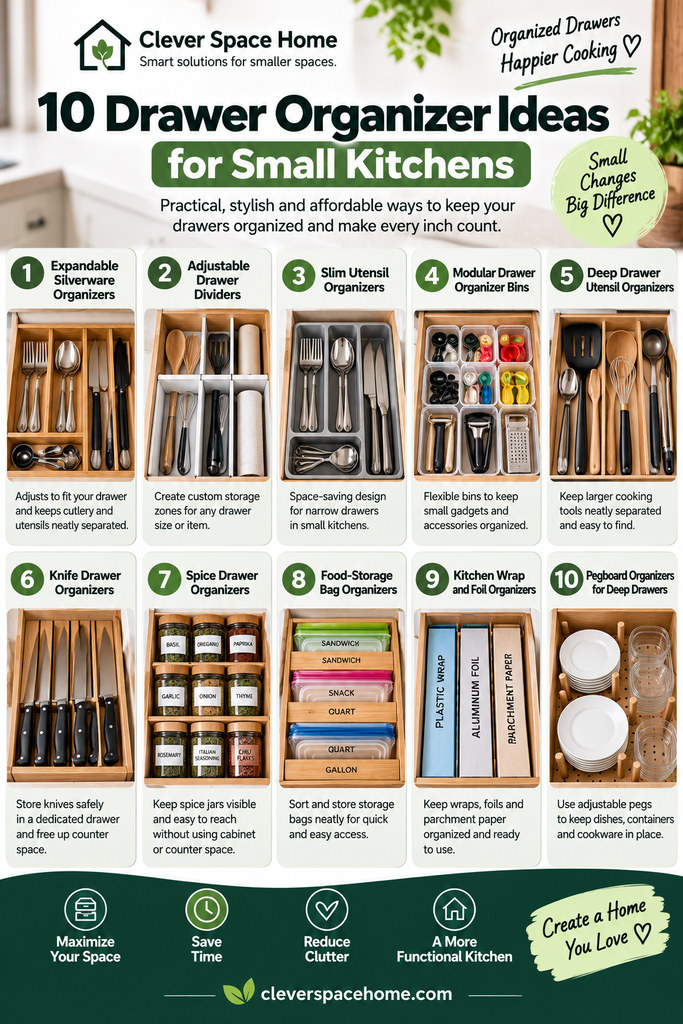
1. Expandable Silverware Organizers
Expandable silverware trays are one of the most practical options for small kitchens because they can adjust to different drawer widths.
The main compartments can hold forks, knives, and spoons, while expandable side sections provide additional room for serving utensils, measuring tools, or other small kitchen items.
Unlike a fixed-width tray, an expandable organizer can use more of the available drawer space. Drawer organizers can also work alongside other best kitchen organizers for small kitchens to create a more efficient overall storage system.
Best for:
Everyday cutlery and mixed utensil drawers.
Small-kitchen tip:
Expand the organizer only as much as necessary. Filling the entire drawer with compartments can leave no flexible space for unusually shaped utensils.
Recommended Option: YouCopia DrawerFit Expandable Organizer
The YouCopia DrawerFit provides an adjustable way to organize everyday kitchen tools and utensils while making better use of the available drawer width. Its expandable design can adapt to different drawer sizes, making it useful when a fixed-width organizer would leave wasted space. Measure the inside of your drawer before buying to make sure the organizer fits comfortably.
Check the YouCopia DrawerFit Expandable Organizer on Amazon → (paid link)
2. Adjustable Drawer Dividers
Adjustable dividers turn an open drawer into customized storage zones.
They are particularly useful when standard organizer trays do not match the dimensions of your drawers. Dividers can separate cooking utensils, baking tools, kitchen towels, wraps, or other items according to the space you actually have.
Many designs can also be repositioned as your storage needs change.
Best for:
Wide drawers and kitchens with unusual drawer dimensions.
Small-kitchen tip:
Create compartments based on categories rather than individual objects. Too many tiny sections can make the drawer harder to maintain.
Recommended Option: SpaceAid Bamboo Drawer Dividers
SpaceAid Bamboo Drawer Dividers let you divide a larger drawer into smaller, more practical storage zones. The adjustable dividers can help separate utensils and other kitchen essentials, while the smaller inserts provide additional flexibility for creating compartments. This approach works particularly well when you want to organize the drawer itself rather than place another full tray inside it.
Check the SpaceAid Bamboo Drawer Dividers on Amazon → (paid link)
3. Slim Utensil Organizers
Traditional silverware trays can take up most of a small drawer. Slim utensil organizers use a narrower layout, and some designs arrange cutlery in overlapping or angled compartments.
This can free part of the drawer for other frequently used items.
They can be especially useful in apartments or compact kitchens where drawer width is limited.
Best for:
Narrow cutlery drawers.
Small-kitchen tip:
Check the organizer’s height carefully. Space-saving designs that stack or overlap utensils may be slightly taller than traditional flat trays.
4. Modular Drawer Organizer Bins
Small modular bins allow you to create a drawer layout using separate containers instead of one large organizer.
Different sizes can be combined to hold measuring spoons, clips, bottle openers, peelers, small gadgets, and other accessories.
The biggest advantage is flexibility. If your storage needs change, individual bins can be moved or rearranged without replacing the entire organizer.
Best for:
Kitchen gadget and miscellaneous utensil drawers.
Small-kitchen tip:
Use only enough bins to create useful categories. Covering every inch with tiny containers can simply replace one form of clutter with another.
Recommended Option: WOWBOX 25-Piece Drawer Organizer Set
The WOWBOX set uses multiple clear organizer bins in different sizes, allowing you to create a drawer layout around the small items you actually need to store. Individual bins can be arranged in different combinations, making this especially useful for miscellaneous kitchen tools and other small items that tend to become mixed together.
Check the WOWBOX 25-Piece Drawer Organizer Set on Amazon → (paid link)
5. Deep Drawer Utensil Organizers
Deep drawers often become cluttered because large cooking tools are stacked on top of one another. Deep drawers can also complement the best cabinet organizers for small kitchens by moving bulky utensils out of crowded cabinet storage.
A deep drawer organizer can create separate areas for spatulas, wooden spoons, tongs, whisks, ladles, and other bulky utensils.
Dividers or long compartments prevent tools from spreading across the entire drawer and make it easier to find what you need without digging through a pile.
Best for:
Cooking utensils and deeper kitchen drawers.
Small-kitchen tip:
Keep the tools you use most frequently toward the front of the drawer.
Recommended Option: Lifewit Expandable Utensil Organizer
The Lifewit Expandable Utensil Organizer is useful for longer cooking tools such as spatulas, tongs, whisks, and serving utensils that do not always fit neatly into standard cutlery compartments. Its expandable layout provides additional storage space when needed while helping keep long utensils separated and easier to find.
Check the Lifewit Expandable Utensil Organizer on Amazon → (paid link)
6. Knife Drawer Organizers
If countertop space is limited, storing knives inside a drawer can help free valuable workspace.
A dedicated in-drawer knife organizer keeps blades separated and provides a defined storage location instead of allowing knives to move loosely inside the drawer.
Depending on the design, knives may be stored horizontally in slots or in slightly angled compartments.
Whatever storage method you use, the USDA Food Safety and Inspection Service recommends keeping knives and other utensils clean as part of safe food preparation.
Best for:
Kitchens where a countertop knife block takes up too much space.
Small-kitchen tip:
Choose an organizer appropriate for the number and size of knives you actually own rather than buying an oversized model.
Recommended Option: Utoplike In-Drawer Bamboo Knife Organizer
The Utoplike In-Drawer Bamboo Knife Organizer keeps knives stored inside a drawer instead of using valuable countertop space for a traditional knife block. Its individual knife slots help keep blades separated and organized while making the collection easier to access. Check your drawer’s internal width, depth, and height before ordering, especially if your knives have larger handles.
Check the Utoplike In-Drawer Bamboo Knife Organizer on Amazon → (paid link)
7. Spice Drawer Organizers
Spice jars do not always need to occupy cabinet or countertop space. Moving spices into a drawer can also free valuable work surfaces when you’re trying to organize a small kitchen counter without clutter.
If you have a suitable drawer near your food-preparation area, an angled or tiered spice drawer organizer can keep jar labels visible and easy to reach.
This arrangement can also prevent small spice containers from disappearing behind larger items in a cabinet.
Best for:
Frequently used spices and shallow-to-medium-depth drawers.
Small-kitchen tip:
Measure both the drawer height and your spice jars before choosing this system.
8. Food-Storage Bag Organizers
Boxes of sandwich, snack, quart, and gallon bags can consume a surprising amount of drawer space.
A dedicated food-storage bag organizer removes the bulky packaging and separates different bag sizes into labeled or divided compartments.
This can create a cleaner, more consistent drawer layout while making individual bags easier to access.
Best for:
Food-preparation and lunch-packing zones.
Small-kitchen tip:
Keep only the bag sizes you regularly use in the main organizer. Less frequently used supplies can be stored elsewhere.
9. Kitchen Wrap and Foil Organizers
Plastic wrap, aluminum foil, parchment paper, and similar rolls often create awkward stacks inside drawers.
A wrap organizer keeps rolls aligned in designated sections. Some designs include built-in cutters, while others simply prevent boxes or rolls from moving around.
Keeping these supplies together also makes it easier to see when something needs replacing.
Best for:
Food-storage supplies and baking zones.
Small-kitchen tip:
Before removing rolls from their original packaging, check whether the organizer is designed to dispense and cut the specific material safely and effectively.
10. Pegboard Organizers for Deep Drawers
Pegboard-style systems are useful for deep drawers containing dishes, bowls, cookware, or food-storage containers.
Movable pegs create boundaries around stacks of items and help prevent them from sliding when the drawer opens or closes.
Because the pegs can usually be repositioned, the layout can adapt when the contents of the drawer change.
Best for:
Deep drawers used for dishes, containers, or cookware.
Small-kitchen tip:
Avoid creating very tall stacks. Easy access is usually more useful than squeezing the maximum possible number of items into one drawer.
Recommended Option: Rev-A-Shelf Wood Pegboard Drawer Organizer
The Rev-A-Shelf Wood Pegboard Drawer Organizer offers a different approach for deeper kitchen drawers. Adjustable pegs can be positioned to create dedicated spaces for larger kitchen items and help prevent them from shifting around whenever the drawer opens or closes. Because drawer dimensions vary considerably, carefully measure the available space before choosing this type of organizer.
Check the Rev-A-Shelf Wood Pegboard Drawer Organizer on Amazon → (paid link)
How to Choose the Best Drawer Organizers for Small Kitchens
The best drawer organizers for small kitchens should improve accessibility without making the drawer unnecessarily complicated.
Before buying an organizer, consider four things: drawer dimensions, the items being stored, how frequently those items are used, and how easily the organizer can be cleaned.
Adjustable and modular designs are particularly useful because they can adapt to different drawer dimensions and changing storage needs.
The goal is not to fill every available inch. It is to create enough structure that items stay organized during normal everyday use.
Organize Drawers by Where Items Are Used
Location matters almost as much as the organizer itself.
Keep cooking utensils near the stove when practical. Cutlery is usually most convenient near the eating or serving area. Food-storage bags and wraps work well near the area where leftovers or lunches are prepared.
This reduces unnecessary movement around the kitchen and makes the organization system easier to maintain.
Put Frequently Used Items in the Easiest-to-Reach Drawers
Not every kitchen tool deserves prime storage space.
Reserve the easiest-to-reach drawers for items used daily or several times per week.
Specialty gadgets, seasonal baking tools, and rarely used accessories can usually be stored in less convenient locations.
In a small kitchen, accessibility should be based on frequency of use rather than simply where an item happens to fit.
Avoid the Kitchen Junk-Drawer Effect
A drawer organizer cannot solve clutter if every miscellaneous item continues to be placed inside it.
Before organizing a drawer, remove anything that does not belong in that storage zone.
Duplicates, broken tools, unused gadgets, old takeaway utensils, and unrelated household items can consume valuable space.
Once the drawer contains only useful kitchen items, organizers become much more effective.
Leave a Little Empty Space
A perfectly packed drawer may look efficient, but it can become frustrating during everyday use.
Leave enough room to remove and return items without rearranging everything else.
A small amount of unused space also gives the drawer flexibility when a new utensil or kitchen accessory is added.
Good organization is about usability, not maximum capacity.
Use Vertical Space Carefully in Deep Drawers
Deep drawers offer additional storage volume, but simply stacking items higher can make lower items difficult to reach.
Use dividers, peg systems, or appropriately sized containers to keep stacks controlled.
For items such as food-storage containers, consider separating lids from containers if doing so makes them easier to retrieve.
The most efficient arrangement is usually the one that lets you see and access most items without removing several others first.
Choose Organizers That Are Easy to Clean
Kitchen drawers naturally collect crumbs, dust, and occasional spills.
Removable trays and bins can make cleaning easier because they can be lifted out individually.
Before buying an organizer, consider whether its corners, compartments, and materials will be practical to clean.
A complicated organizer that is difficult to maintain may eventually become more frustrating than a simpler solution.
Build Your Drawer Organization System Gradually
You do not need to reorganize every kitchen drawer at once.
Start with the drawer that causes the most frustration.
Remove everything, decide what genuinely belongs there, measure the available space, and then choose an organizer based on the remaining items.
Use the drawer normally for a while before organizing the next one.
This gradual approach helps reveal which solutions actually improve your kitchen instead of buying several organizers before understanding what you need.
Frequently Asked Questions
What is the best way to organize kitchen drawers in a small kitchen?
Start by grouping items according to purpose and frequency of use. Keep everyday items in easy-to-reach drawers and use appropriately sized trays, dividers, or modular bins to create clear storage zones.
Are adjustable drawer organizers better than fixed organizers?
Neither option is automatically better. Adjustable organizers are useful for unusual drawer dimensions or changing storage needs, while fixed trays can work well when their dimensions closely match the drawer and the items being stored.
How do I organize a very narrow kitchen drawer?
Consider slim silverware organizers, small modular bins, or adjustable dividers. Measure the drawer carefully before purchasing anything, particularly its interior width and height.
What should I put in deep kitchen drawers?
Deep drawers can work well for cooking utensils, food-storage containers, dishes, cookware, or kitchen linens. Dividers and pegboard systems can help prevent larger items from shifting or becoming disorganized.
Are drawer organizers worth using in a small kitchen?
They can be particularly useful in a small kitchen because they create defined storage zones and make limited drawer space easier to use. However, the organizer should match the contents of the drawer rather than simply adding more compartments.
Final Thoughts
The best drawer organizers for small kitchens are not necessarily the largest or most complicated. The most useful solutions make everyday items easier to find, use, and return to their proper place.
Expandable silverware trays, adjustable dividers, slim utensil organizers, modular bins, knife storage, spice organizers, and deep-drawer systems can all solve different storage problems.
Start by measuring your drawers and identifying the areas that create the most frustration. Then choose organizers that solve those specific problems.
With a few carefully selected solutions, even limited kitchen drawer space can become organized, accessible, and much easier to maintain.
3 thoughts on “Best Drawer Organizers for Small Kitchens: 10 Space-Saving Ideas”
Comments are closed.