
Disclosure: This post contains affiliate links. If you purchase through these links, we may earn a commission at no additional cost to you.
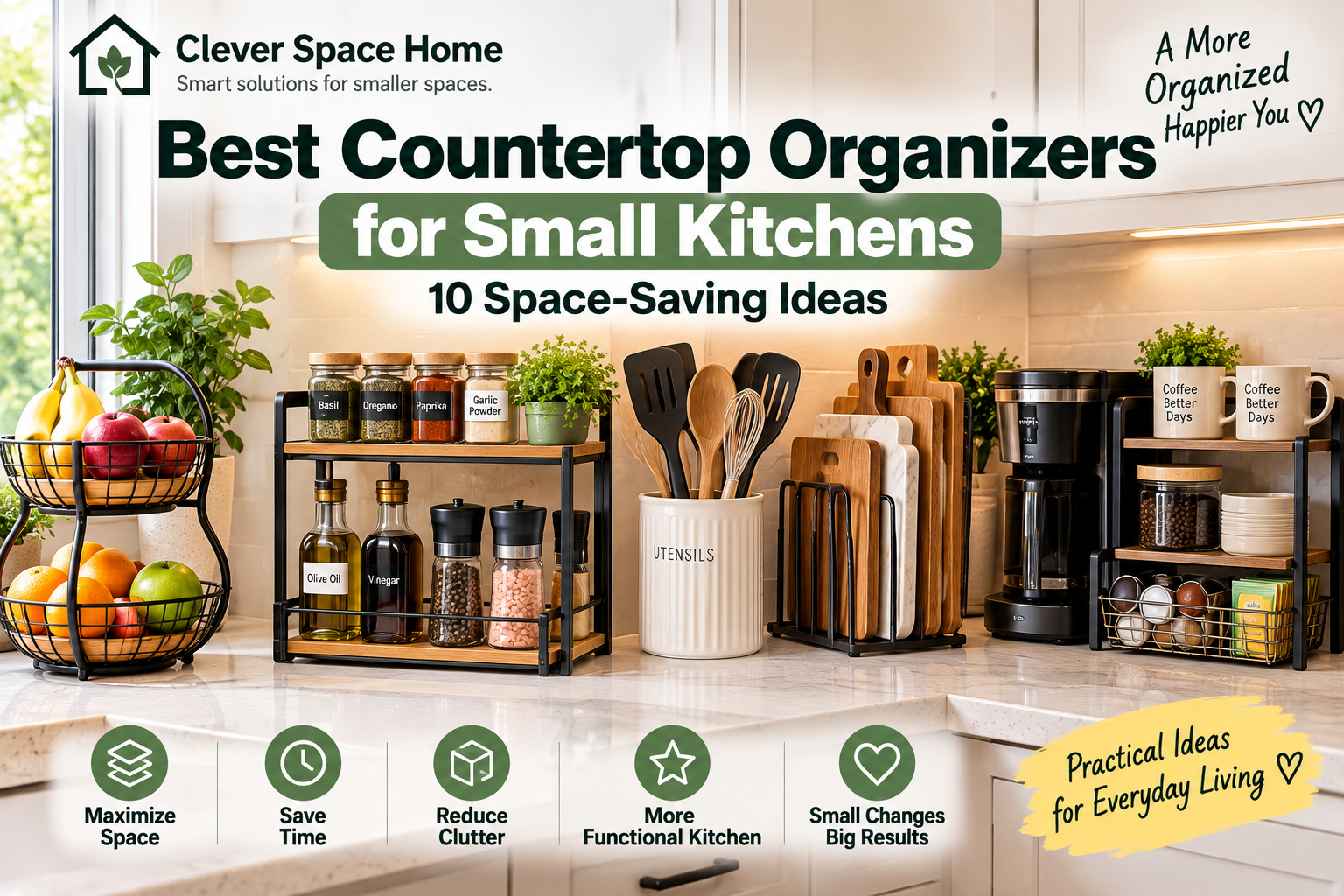
Choosing the best countertop organizers for small kitchens can help turn a crowded work surface into a more practical place for cooking and everyday tasks. When counter space is limited, even a few appliances, cooking utensils, spice containers, or food items can make the kitchen feel cluttered.
The goal, however, is not simply to fit more things onto the counter.
Good countertop organization should preserve as much usable work surface as possible while keeping frequently used items easy to reach. The right organizer can make better use of corners, vertical space, walls, and areas around appliances without making the counter feel overcrowded.
Before buying countertop organizers, consider what actually needs to remain visible. Items used every day may deserve a permanent place on the counter, while equipment used only occasionally may be better stored inside a cabinet.
Below are 10 practical countertop organizer types that can help maximize limited space while keeping a small kitchen functional.
Table of Contents
Before Buying Countertop Organizers, Measure Your Space
Before choosing an organizer, measure the area where you intend to place it.
Check the available:
- Width
- Depth
- Height
- Clearance beneath upper cabinets
Upper-cabinet clearance is particularly important for tall organizers, coffee stations, fruit baskets, paper-towel holders, and appliances with lids that open upward.
Also consider nearby electrical outlets. An organizer should not make it difficult to plug in appliances or encourage cords to stretch awkwardly across the work surface.
Measure the items you intend to store as well.
A tiered organizer may fit comfortably beneath a cabinet but still be too narrow for the bottles or containers you want to place on it.
Finally, remember that an organizer occupying every available inch of counter space defeats the purpose. If clutter is the bigger problem, start with our guide on how to organize a small kitchen counter without clutter before deciding which organizers you actually need. Leave enough open surface for food preparation and everyday kitchen tasks.
1. Tiered Countertop Organizers
A tiered organizer creates multiple storage levels while using a relatively small amount of counter space. Tiered storage is also one of several useful options covered in our guide to the best kitchen organizers for small kitchens.
Instead of spreading several bottles, jars, or containers across the work surface, you can arrange them vertically.
Tiered organizers can work particularly well for:
- Cooking oils
- Frequently used spices
- Condiments
- Coffee supplies
- Small jars
- Tea accessories
They can also improve visibility because items stored on the upper levels are less likely to disappear behind those in front.
For a small kitchen, choose a size that holds frequently used essentials without becoming a permanent collection point for miscellaneous items.
Recommended Option: IBUYKE 3-Tier Countertop Organizer
The IBUYKE 3-Tier Countertop Organizer uses three open levels to make better use of vertical space while keeping frequently used items within easy reach. Its relatively shallow design can work well on smaller kitchen counters where you want extra storage without taking up too much depth. Before buying, measure both your available countertop space and the clearance below any upper cabinets.
Check the IBUYKE 3-Tier Countertop Organizer on Amazon → (paid link)
2. Countertop Corner Shelves
Kitchen corners often become awkward spaces where individual bottles, appliances, or containers accumulate.
A corner shelf can turn that area into structured vertical storage.
Depending on its design, a corner organizer may provide two or three levels for small kitchen essentials.
Possible uses include:
- Spices
- Coffee supplies
- Mugs
- Small bowls
- Cooking oils
- Decorative items
Corner organizers are most useful when they make an otherwise difficult area easier to access.
Avoid filling them simply because extra shelves are available. Keeping some open space around the organizer can prevent the counter from feeling visually crowded.
3. Countertop Turntables
A countertop turntable, often called a lazy Susan, can keep several frequently used items together while making each one easy to reach.
Instead of moving bottles around to reach something at the back, rotate the tray.
This can work well near the cooking area for:
- Cooking oils
- Salt and pepper
- Sauces
- Frequently used seasonings
It can also be useful in a coffee or beverage station.
Before buying one, check its diameter carefully. Round organizers can occupy more countertop depth than expected.
Choose one large enough for the items you actually use but small enough to preserve surrounding workspace.
4. Utensil Holders with Compartments
Cooking utensils often need to remain close to the stove, but a large container filled with unrelated tools can quickly become cluttered.
A divided utensil holder separates frequently used tools into simple categories.
For example, different compartments might hold:
- Wooden spoons
- Spatulas
- Tongs
- Whisks
- Serving utensils
The main advantage is easier access.
However, countertop utensil storage works best when limited to tools used regularly. Duplicate utensils and specialty tools used occasionally can usually be stored in a drawer.
A smaller, carefully selected group of utensils takes up less counter space and is easier to keep clean.
Recommended Option: ALELION Large Utensil Holder
The ALELION Large Utensil Holder provides four compartments for separating everyday cooking tools instead of keeping everything mixed together in one container. Its removable dividers give you some flexibility in how the space is arranged, while the compact upright design keeps utensils accessible without spreading them across the countertop.
Check the ALELION Large Utensil Holder on Amazon → (paid link)
5. Vertical Cutting Board and Tray Organizers
Cutting boards, serving trays, and baking sheets can sometimes be stored vertically on the countertop when cabinet storage is limited.
A vertical rack keeps them separated and prevents them from leaning against appliances or walls. If you would rather keep these items off the countertop, our guide to the best cabinet organizers for small kitchens includes vertical cabinet-storage options.
This type of organizer may work well for:
- Everyday cutting boards
- Small serving trays
- Frequently used baking sheets
- Cooling racks
However, countertop storage should be reserved for items you use often.
If a large collection of trays or boards begins occupying valuable preparation space, storing most of them vertically inside a cabinet may be more practical.
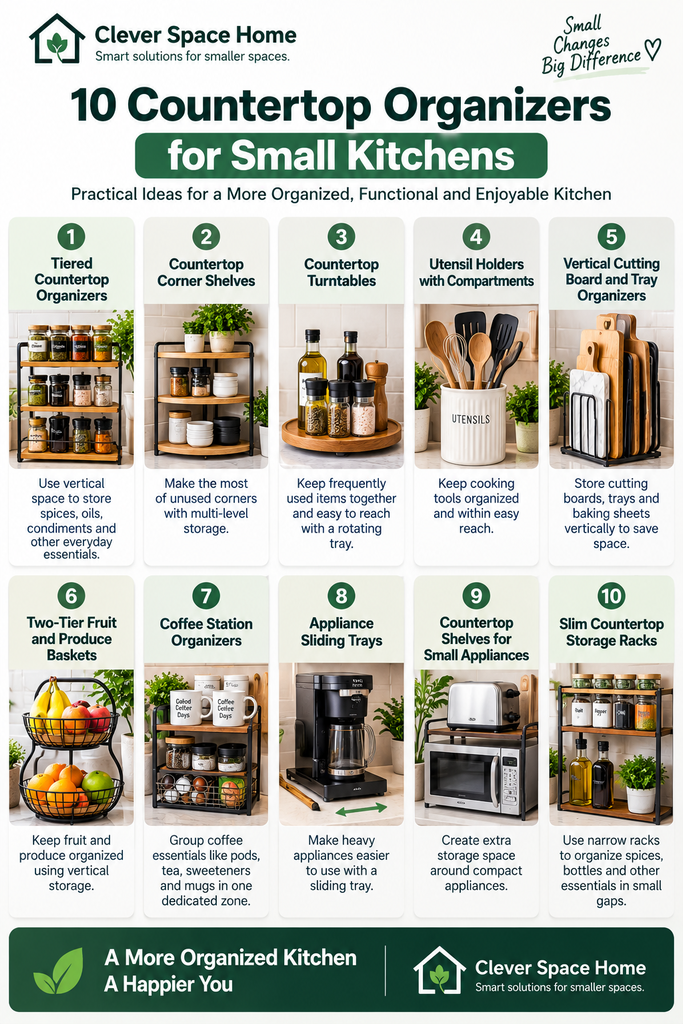
6. Two-Tier Fruit and Produce Baskets
Fruit bowls can occupy a surprising amount of counter space.
A two-tier basket creates additional vertical capacity while using approximately the same footprint as a single container.
Depending on your household, it can be used for:
- Fruit
- Certain vegetables suitable for room-temperature storage
- Snacks
- Bread or packaged items
Separate tiers can also help keep different types of food organized.
Avoid overfilling the basket. Produce should remain visible enough that you notice what needs to be used before it spoils.
A removable basket can also make cleaning easier.
Recommended Option: Lawhood Mijin 2-Tier Fruit Basket
The Lawhood Mijin 2-Tier Fruit Basket stacks two open wire baskets vertically, helping you store produce without using the countertop space of two separate baskets. The baskets can also be detached and used separately when that arrangement works better for your kitchen. Its open design makes it easy to see and access the contents.
Check the Lawhood Mijin 2-Tier Fruit Basket on Amazon → (paid link)
7. Coffee Station Organizers
Coffee equipment can quickly spread across a small counter.
The coffee maker itself may occupy significant space, followed by mugs, coffee, tea, filters, sweeteners, pods, spoons, and other accessories.
A compact coffee-station organizer can group these items into one defined zone.
Depending on your setup, useful storage might include:
- Coffee pods
- Tea bags
- Filters
- Sweeteners
- Stirring spoons
- Small mugs
The key is keeping the station proportional to the kitchen.
If you drink coffee every day, a dedicated zone can be practical. If the equipment is used only occasionally, permanent countertop storage may not be worth the space.
Recommended Option: ANBOXIT 2-Tier Coffee Station Organizer
The ANBOXIT 2-Tier Coffee Station Organizer creates dedicated vertical storage for coffee supplies such as syrups, jars, pods, mugs, or other frequently used accessories. Its two-level design helps keep a coffee setup together while reducing the amount of countertop area those individual items would otherwise occupy.
Check the ANBOXIT 2-Tier Coffee Station Organizer on Amazon → (paid link)
8. Appliance Sliding Trays
Small appliances stored beneath upper cabinets can be awkward to use.
Coffee makers, blenders, mixers, and other equipment may need to be pulled forward before use and pushed back afterward.
An appliance sliding tray creates a movable platform that allows the appliance to slide forward more easily.
This can be useful for appliances that are:
- Used frequently
- Heavy or awkward to move
- Stored beneath upper cabinets
- Positioned close to a wall
Before choosing a tray, check its weight capacity and dimensions.
Also ensure there is enough counter depth for the appliance to move forward safely without approaching the edge too closely.
Recommended Option: ANBOXIT Appliance Sliding Tray
The ANBOXIT Appliance Sliding Tray provides a simple way to move countertop appliances forward when you need them and slide them back afterward. This can be particularly useful for coffee makers and other appliances normally kept beneath upper cabinets, where repeatedly lifting or dragging an appliance can be inconvenient. Check that the tray dimensions suit your particular appliance before ordering.
Check the ANBOXIT Appliance Sliding Tray on Amazon → (paid link)
9. Countertop Shelves for Small Appliances
When several compact appliances or kitchen accessories compete for counter space, a sturdy countertop shelf can create another storage level.
For example, a shelf system designed for use around a microwave might provide storage above or around an appliance, while smaller racks may create room above a toaster or other equipment.
The exact arrangement depends heavily on the appliance and manufacturer’s clearance requirements.
Never block ventilation openings or place items where heat could create a safety problem. For countertop appliances, the U.S. Consumer Product Safety Commission also recommends following the manufacturer’s instructions and keeping appliances away from water and other hazards.
The organizer should create useful storage without interfering with the safe operation of the appliance.
10. Slim Countertop Storage Racks
A narrow storage rack can make use of small gaps along a backsplash or beside an appliance.
These organizers may be useful for:
- Spice jars
- Small bottles
- Coffee accessories
- Condiments
- Frequently used cooking ingredients
Their main advantage is a relatively small footprint.
However, measure carefully before buying. Even a few extra inches of depth can significantly reduce usable preparation space on a narrow countertop.
Look for an organizer that uses vertical space rather than extending too far into the work surface.
How to Choose the Best Countertop Organizers for Small Kitchens
The best organizer depends on the specific problem you are trying to solve.
If bottles and spices are spreading across the counter, a tiered organizer or turntable may help.
If an unused corner collects clutter, a corner shelf may make better use of the space.
If fruit occupies too much surface area, a two-tier basket can add vertical storage.
If a heavy appliance is difficult to move, a sliding tray may improve accessibility.
And if too many utensils surround the stove, a compact divided holder may provide a simpler system.
Start with the problem first and choose the organizer second.
This approach helps prevent buying attractive storage products that ultimately add more clutter than they remove.
Keep a Dedicated Food-Preparation Zone
Even an organized countertop can become inconvenient if there is nowhere to prepare food.
Try to preserve at least one clear section of counter for everyday tasks such as:
- Chopping vegetables
- Preparing sandwiches
- Mixing ingredients
- Plating meals
- Unpacking groceries
Avoid allowing organizers to gradually spread into this area.
A defined preparation zone provides a useful boundary: if a new countertop item begins occupying that space, something else may need to move.
Use Vertical Space Before Expanding Sideways
Countertop organizers are most useful in a small kitchen when they make better use of height.
Tiered shelves, vertical racks, and stacked baskets can increase storage capacity without consuming the same amount of horizontal workspace.
But vertical storage also has limits.
Avoid creating tall stacks that are unstable, difficult to clean, or inconvenient beneath upper cabinets.
The goal is practical storage, not maximum density.
Keep Everyday Items Near Where You Use Them
Countertop organization works best when storage follows the kitchen workflow.
Cooking oils and frequently used seasonings may make sense near the cooking area.
Coffee supplies belong near the coffee maker.
Cutting boards may be most convenient near the main preparation surface.
Fruit may work better away from the stove or other heat sources.
When items are stored near where they are used, you spend less time carrying them across the kitchen and are more likely to return them to their designated place.
Avoid Turning Organizers Into Clutter Containers
An organizer does not automatically make its contents organized.
A basket filled with unrelated objects is still clutter—it simply has boundaries around it.
Periodically check countertop organizers and remove items that do not belong there.
Ask whether each item:
- Is used frequently
- Needs to remain on the counter
- Belongs in that particular zone
- Could be stored more efficiently elsewhere
This simple review prevents organizers from gradually becoming permanent catch-all spaces.
Leave Some Countertop Space Empty
Empty space is useful.
It makes a small kitchen feel calmer, provides room for temporary tasks, and makes surfaces easier to clean.
You do not need to place an organizer in every available corner. If limited food storage is forcing pantry items onto your counters, our guide on how to organize a small kitchen without a pantry offers additional storage strategies.
In fact, one of the most effective ways to improve a crowded countertop may be to remove something rather than add another storage product.
Use organizers selectively where they solve a genuine problem.
Think About Cleaning Before Choosing an Organizer
Countertop organizers are exposed to cooking residue, crumbs, splashes, and dust.
Complicated organizers with many narrow openings may take longer to clean than simple trays or racks.
Before buying, consider:
- Whether surfaces can be wiped easily
- Whether baskets or trays are removable
- Whether the organizer can be moved for cleaning underneath
- Whether spills could become trapped
- Whether the material suits the area where it will be used
A countertop organization system should make the kitchen easier to maintain, not create additional cleaning work.
Build Your Countertop System Gradually
You do not need to purchase several organizers at once.
Start with the area causing the most frustration.
Remove everything from that section of the counter and decide what genuinely needs to return.
Then identify the problem.
Perhaps bottles need vertical storage, an appliance needs easier movement, or fruit needs a smaller footprint.
Choose one organizer that addresses that specific issue and use it for a while before adding another.
This gradual approach helps you discover what actually works in your kitchen and reduces the chance of buying unnecessary storage products.
Frequently Asked Questions
What should I keep on a small kitchen counter?
Prioritize items used frequently, such as an everyday appliance, a small selection of cooking utensils, or ingredients used regularly. Items used occasionally are usually better stored inside cabinets or drawers.
How do I organize a kitchen counter with very little space?
Start by removing unnecessary items, then use vertical storage where appropriate. Tiered organizers, corner shelves, compact utensil holders, and two-tier baskets can provide storage without occupying as much horizontal surface.
Are countertop organizers worth buying?
They can be useful when they solve a specific problem, such as inaccessible bottles, scattered utensils, or an appliance that is difficult to move. An organizer that merely creates space for additional clutter is less useful.
How can I make my small kitchen counter look less cluttered?
Keep only frequently used items visible, group related objects into defined zones, use a limited number of organizers, and preserve some empty counter space.
Where should appliances go in a small kitchen?
Frequently used appliances may deserve countertop space if they fit safely and do not interfere with food preparation. Appliances used occasionally can often be stored in a cabinet or another accessible storage area.
How many countertop organizers should I use?
There is no ideal number. Use only as many as necessary to solve genuine storage problems while preserving sufficient open workspace.
Final Thoughts
The best countertop organizers for small kitchens help improve access and storage without sacrificing the work surface you need for cooking.
Tiered organizers can make better use of vertical space, corner shelves can improve awkward areas, turntables can keep frequently used bottles accessible, and sliding trays can make countertop appliances easier to use.
But adding organizers should not be the first response to every clutter problem.
Remove unnecessary items first, decide what genuinely needs to remain on the countertop, and then choose organizers that solve specific problems.
A well-organized small kitchen counter should still have some empty space.
By using organizers selectively and keeping everyday items near where they are used, you can create a countertop that feels less crowded, is easier to clean, and works better for everyday cooking.
3 thoughts on “Best Countertop Organizers for Small Kitchens: 10 Space-Saving Ideas”
Comments are closed.