
Disclosure: This post contains affiliate links. If you purchase through these links, we may earn a commission at no additional cost to you.
Food storage can take up a surprising amount of space in a small kitchen. Plastic containers spread across cabinets, lids become separated from their matching bases, pantry packages pile up, and leftovers compete for limited refrigerator space.
The problem is often not the number of containers you own. It is how efficiently they fit together and whether every type of food storage has a practical home.
The best food storage organizers for small kitchens can make containers, lids, dry foods, wraps, and leftovers easier to store and find. A good system also helps prevent cabinets from becoming crowded with mismatched containers you rarely use.
You do not need to replace everything with a perfectly matching set. Start with the storage problem that causes the most frustration and improve that area first.
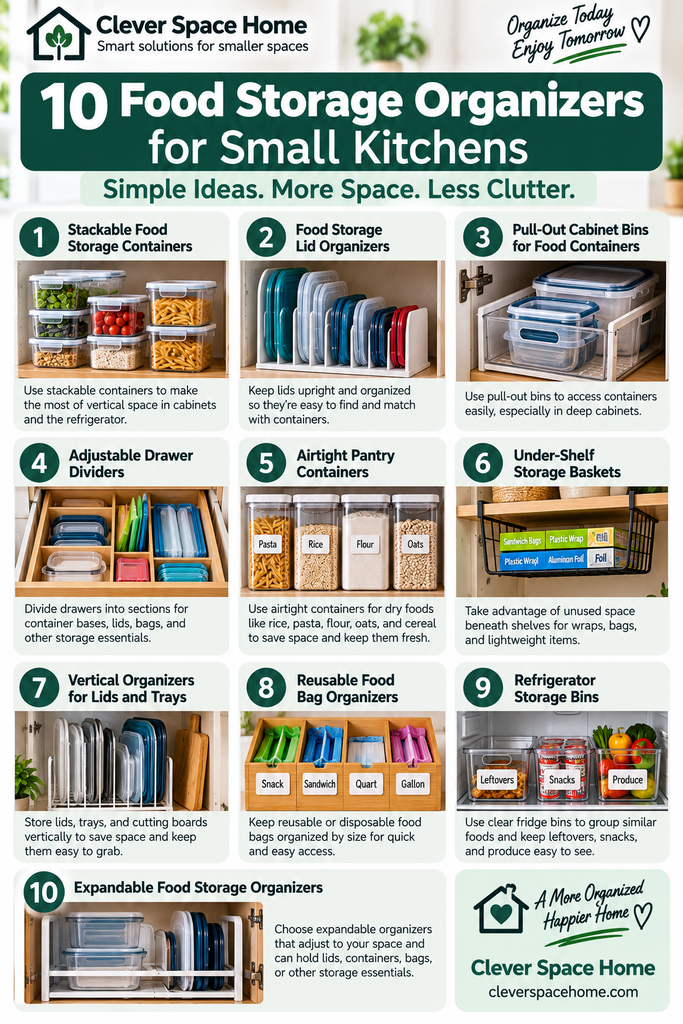
Below are 10 practical food storage organizer ideas for making better use of limited kitchen space.
Table of Contents
Before Choosing Food Storage Organizers, Review What You Actually Use
Before buying another organizer, take your existing food-storage containers out of the cabinet.
Match each container with its lid and look for pieces that are cracked, badly stained, warped, or missing their matching part.
Then consider which sizes you actually use.
If your household mainly stores individual portions and leftovers, several medium-size containers may be more useful than a large collection of specialty sizes.
Also measure the cabinet, drawer, pantry shelf, or refrigerator area where the organizers will be used.
If food-storage containers are currently taking over your cabinets, our guide on how to organize kitchen cabinets in a small kitchen can help you establish better storage zones first.
The goal is not to fit the greatest possible number of containers into the kitchen. It is to make the containers you regularly use easier to access.
1. Stackable Food Storage Containers
Stackable containers can make much better use of vertical cabinet and refrigerator space than containers with irregular shapes.
Look for containers with compatible footprints so several sizes can stack securely.
Square and rectangular designs generally use shelf space efficiently because they can sit closely beside one another.
Stacking also makes it easier to create dedicated areas for leftovers, meal preparation, or dry ingredients.
Avoid building stacks so tall that removing the bottom container becomes inconvenient.
A smaller, stable stack is usually more practical than maximizing every inch of vertical space.
Recommended Product: Pharamat Collapsible Silicone Food Storage Containers
In a small kitchen, food containers need to be easy to store both when they are full and when they are empty. These Pharamat silicone food storage containers have a collapsible design that reduces the amount of cabinet or drawer space they require when they are not being used.
Their stackable format can also help keep stored food organized without creating unstable piles of mismatched containers. For the best use of limited storage space, keep only the container sizes you regularly need and collapse empty containers before putting them away.
Check the Pharamat Collapsible Food Storage Containers on Amazon → (paid link)
2. Food Storage Lid Organizers
Lids are often the most frustrating part of food-storage organization.
A dedicated lid organizer keeps them upright instead of allowing them to spread across an entire cabinet.
Adjustable dividers can be particularly useful because different container sets may have different lid sizes.
You can organize lids by:
- Size
- Shape
- Container type
- Frequency of use
Keep lids close to the matching container bases rather than storing them on the opposite side of the kitchen.
The simpler the system, the easier it will be to maintain.
Recommended Product: YouCopia StoraLid Food Container Lid Organizer
Food-container lids can quickly become difficult to manage when different sizes and shapes are stored together. The YouCopia StoraLid provides a dedicated place for keeping lids upright and separated, making it easier to find the right lid without searching through a loose stack.
Its adjustable divider system can be arranged around the lid sizes you actually own. This can be particularly useful in a small cabinet or drawer where keeping lids organized vertically makes better use of the available space.
Check the YouCopia StoraLid Organizer on Amazon → (paid link)
3. Pull-Out Cabinet Bins for Food Containers
Deep cabinets can hold many containers but make those at the back difficult to reach.
A pull-out bin lets you bring a group of containers forward rather than reaching behind several stacks.
This can work especially well for lightweight plastic containers, lunch containers, reusable bags, or baking-storage supplies.
Before choosing a pull-out organizer, measure around hinges, plumbing, and other cabinet obstacles.
Our guide to the best cabinet organizers for small kitchens includes additional solutions for making deep cabinets more accessible.
4. Adjustable Drawer Dividers
A deep kitchen drawer can be an excellent location for food-storage containers when it is divided into practical sections.
Adjustable drawer dividers can separate:
- Container bases
- Lids
- Reusable bags
- Small lunch containers
- Food-storage accessories
This prevents different pieces from sliding together whenever the drawer opens.
Drawer storage can also make containers easier to see from above.
If you already use drawers for several kitchen categories, our guide to the best drawer organizers for small kitchens offers additional ways to divide limited drawer space.
5. Airtight Pantry Containers
Dry-food packages can create clutter because boxes and bags come in many different shapes.
Airtight containers can create a more uniform system for foods such as:
- Rice
- Pasta
- Flour
- Sugar
- Oats
- Cereal
- Dried beans
Rectangular containers generally make efficient use of pantry and cabinet shelves.
However, transferring every grocery item into a matching container is not necessary.
Use airtight storage where it improves freshness, visibility, or space efficiency.
If dry-food organization is one of your main challenges, our guide to the best pantry organizers for small kitchens covers additional pantry-storage solutions.
6. Under-Shelf Storage Baskets
Under-shelf baskets use the shallow space immediately beneath an existing shelf.
They can be useful for lightweight food-storage items such as reusable bags, wraps, small lids, or snack packets.
This type of organizer can be particularly helpful when there is too much vertical space between cabinet shelves.
Because under-shelf baskets reduce the clearance beneath them, measure the height of items stored on the shelf below before installing one.
They should create useful storage rather than making the rest of the cabinet harder to use.
7. Vertical Organizers for Container Lids and Trays
Vertical storage is useful for flat items that otherwise become unstable when stacked.
A divider-style organizer can hold container lids, shallow food-storage trays, cutting boards, or reusable baking mats upright.
This allows individual pieces to be removed without disturbing an entire pile.
Choose compartments that are wide enough for your lids but narrow enough to keep them standing.
Vertical organizers are particularly useful in lower cabinets where you can easily see the contents from above.
8. Reusable Food Bag Organizers
Reusable silicone bags and disposable food-storage bags can quickly become disorganized when boxes and loose bags share the same drawer.
A dedicated bag organizer can create separate sections for different sizes.
For example:
- Snack
- Sandwich
- Quart
- Gallon
If you primarily use reusable bags, make sure they are completely dry before storing them.
The organizer itself should fit your normal purchasing habits rather than forcing you to buy a particular type of bag simply because it fits the compartments.
Recommended Product: SpaceAid Bag Storage Organizer
Boxes and packages of food-storage bags can take up more drawer space than necessary and become difficult to keep organized. The SpaceAid bag organizer creates dedicated compartments for different bag sizes, allowing commonly used food-storage bags to be kept together in one defined area.
A compartment-style organizer can also make it easier to see when a particular bag size is running low. Before placing it in a drawer, measure the available space and make sure its dimensions work with your existing drawer layout.
Check the SpaceAid Bag Storage Organizer on Amazon → (paid link)
9. Refrigerator Storage Bins
Food storage does not stop at the kitchen cabinets.
Clear refrigerator bins can group similar refrigerated foods and make leftovers easier to see.
Useful categories might include:
- Leftovers
- Lunch supplies
- Snacks
- Breakfast items
- Sauces
- Produce
Removable bins can also make refrigerator shelves easier to clean.
Avoid overcrowding refrigerator bins or blocking airflow. Food should continue to be stored according to appropriate refrigeration and food-safety guidance.
Recommended Product: Mpotmiy Refrigerator Organizer Bins
Creating defined storage areas inside the refrigerator can prevent smaller food items from getting lost behind larger packages. These Mpotmiy refrigerator organizers can help group related items together so they are easier to locate and return to the same place after use.
For a small refrigerator, avoid filling every shelf with organizers. Use bins where they solve a specific storage problem, while preserving enough open space for larger containers, leftovers, and items that change from week to week.
Check the Mpotmiy Refrigerator Organizer Bins on Amazon → (paid link)
10. Expandable Food Storage Organizers
Expandable organizers can adapt to different cabinet or drawer widths.
Depending on the design, they may hold lids, containers, reusable bags, wraps, or other food-storage accessories.
This flexibility can be useful in small kitchens because storage needs often change over time.
Measure both the minimum and maximum dimensions before buying.
An adjustable organizer is only useful if its expansion range matches the space where you intend to use it.
How to Choose the Best Food Storage Organizers for Small Kitchens
The best food storage organizers for small kitchens should make everyday storage easier rather than simply making a cabinet look more organized.
Consider these factors before choosing one.
Measure the Available Space
Measure the usable width, depth, and height.
Remember to account for cabinet hinges, drawer hardware, shelf supports, and other obstacles.
Consider What You Store Most Often
A family that regularly stores leftovers may need a different system from someone who mainly uses containers for meal preparation or dry pantry foods.
Organize around actual habits.
Prioritize Easy Access
Frequently used containers should not require removing several other items first.
Keep everyday sizes within comfortable reach.
Choose Flexible Systems
Adjustable dividers, modular bins, and stackable containers can adapt when your storage needs change.
Highly specialized organizers may become less useful if you later change container brands or sizes.
Store Containers with Similar Shapes Together
Mixing round, square, and rectangular containers in one stack often wastes space.
Group containers with similar shapes and footprints.
Square containers can stack together, while round containers can have their own smaller section.
You do not need every container to match.
The goal is simply to prevent incompatible shapes from creating unstable piles.
Nest Containers When It Makes Sense
Empty containers can often be nested inside one another to save cabinet space.
However, nesting works best when containers can still be separated easily.
Do not force containers tightly together, especially if doing so makes them difficult to remove.
Store lids separately in a nearby organizer if attaching every lid makes the containers consume significantly more space.
Keep Everyday Containers Easy to Reach
Think about which food-storage pieces you use several times each week.
Those containers should receive the most accessible cabinet or drawer space.
Occasional-use containers can go on higher shelves or toward the back.
This simple priority system prevents specialty containers from occupying valuable everyday storage.
Avoid Keeping Too Many Duplicate Sizes
Having several containers of the same useful size can be practical.
Having far more than you regularly use creates clutter.
If one cabinet is overflowing, consider how many containers are normally in use at the same time.
Keep a reasonable buffer, but remove pieces that consistently remain unused.
This can create more usable space without buying any organizer at all.
Keep Food-Storage Materials Safe and Appropriate
Use containers according to their manufacturer’s instructions, particularly when heating, freezing, or washing them.
Stop using food-storage containers that are cracked, badly damaged, or no longer close properly, and follow applicable local guidance for disposal or recycling.
For refrigerated foods and leftovers, follow appropriate food-safety practices.
The USDA Food Safety and Inspection Service provides guidance on safely storing leftovers and refrigerated foods.
Label Stored Food When It Is Helpful
Labels can be useful for dry ingredients or prepared foods that are difficult to identify.
For leftovers, adding the date can help you remember when the food was stored.
However, avoid creating a complicated labeling system that makes everyday storage inconvenient.
The best system is one your household will actually maintain.
Build Your Food Storage System Gradually
You do not need to replace every container and organizer at once.
Start with the biggest problem.
If loose lids create the most frustration, organize those first.
If deep cabinets are difficult to use, introduce a pull-out bin.
If dry-food packages dominate your pantry, improve that area next.
Living with each improvement for a while helps reveal whether another organizer is actually necessary.
Frequently Asked Questions
What is the best way to organize food storage containers in a small kitchen?
Group similar container shapes and sizes together, nest compatible containers, and keep lids upright in a dedicated organizer. Store frequently used pieces within easy reach.
Should food storage containers be stored with lids on or off?
Either method can work. Keeping lids attached makes matching easy but usually takes more space. Nesting container bases and storing lids separately is often more space-efficient in small kitchens.
How do I organize food storage lids?
Store lids vertically using a lid organizer, adjustable divider, or narrow bin. Grouping them by size or shape can make matching them with containers faster.
Are square food storage containers better for small kitchens?
Square and rectangular containers generally use shelf and refrigerator space efficiently because they fit closely together. However, existing round containers do not need to be replaced if they already work well.
How many food storage containers should I keep?
There is no ideal number. Keep enough for your normal leftovers, lunches, and meal preparation plus a reasonable buffer. If containers consistently remain unused, you may have more than you need.
Can I use pantry organizers for food storage containers?
Yes. Pull-out bins, shelf risers, baskets, and adjustable organizers designed for pantry or cabinet use can also work well for food-storage containers when the dimensions are suitable.
Final Thoughts
The best food storage organizers for small kitchens make containers and stored food easier to see, reach, and use.
Stackable containers can improve vertical storage, lid organizers prevent loose pieces from spreading across cabinets, drawer dividers create practical zones, and pull-out bins make deep storage more accessible.
The most effective solution depends on the way your household actually stores food.
Start by removing damaged and unused pieces, organize what remains, and then add an organizer only where it solves a specific problem.
A smaller, well-planned collection of food-storage containers is often easier to manage than a crowded cabinet filled with organizers and containers you rarely use.
5 thoughts on “Best Food Storage Organizers for Small Kitchens: 10 Space-Saving Ideas”
Comments are closed.