
Disclosure: This post contains affiliate links. If you purchase through these links, we may earn a commission at no additional cost to you.
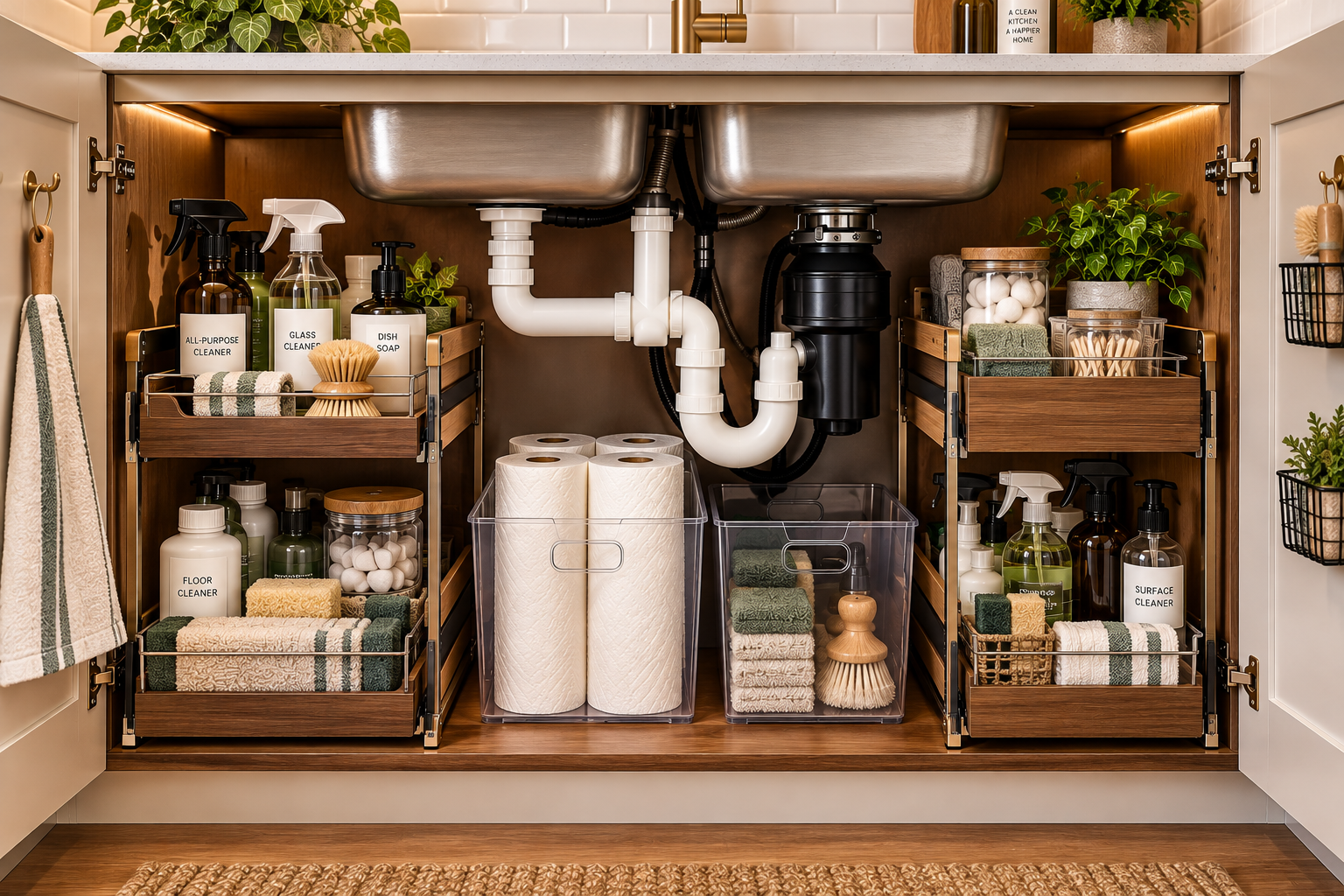
Choosing the best under-sink organizers for small kitchens starts with understanding why this cabinet is so difficult to organize. Plumbing, the sink basin, garbage disposal equipment, cabinet hinges, and other obstructions can dramatically reduce the usable space inside.
In a small kitchen, wasting this cabinet can be particularly frustrating. Cleaning sprays, dishwashing supplies, trash bags, sponges, brushes, and other household essentials can quickly become a crowded collection of bottles and containers.
The best under-sink organizers for small kitchens help turn this awkward cabinet into useful storage without interfering with plumbing or making everyday supplies difficult to reach.
However, not every organizer works in every cabinet. A wide two-tier system may be perfect for one kitchen but impossible to install in another because of a drainpipe. The goal is therefore not simply to buy more organizers. It is to choose storage solutions that fit around the obstacles already inside your cabinet.
Here are 10 practical under-sink organizer types worth considering, along with guidance on where each works best.
Table of Contents
Before Buying an Under-Sink Organizer, Measure the Cabinet
Measuring is particularly important under a kitchen sink because the usable storage area can be very different from the cabinet’s external dimensions.
Open the cabinet and measure the usable width, depth, and height.
Then identify everything that reduces that space, including:
- drainpipes
- water-supply lines
- garbage disposal units
- cabinet hinges
- sink basins
- filtration systems
- electrical outlets or wiring
- other plumbing components
Measure the available space on both sides of the plumbing, not simply from one cabinet wall to the other.
Also measure the cabinet-door opening. An organizer may technically fit inside the cabinet but still be difficult or impossible to slide through the opening.
If you want to establish the overall storage system before choosing individual organizers, our guide on how to organize under the kitchen sink in a small kitchen explains how to create practical storage zones around plumbing and everyday supplies.
Once you know the actual usable dimensions, you can choose an organizer based on the space you really have.
1. Two-Tier Under-Sink Organizers
Two-tier organizers are one of the most useful options when a cabinet has enough vertical clearance.
Instead of keeping everything across the cabinet floor, these organizers create a second storage level.
The lower tier can hold larger cleaning bottles or refill containers, while the upper tier can hold smaller items such as sponges, dishwasher tablets, gloves, or cleaning cloths.
Best for
Two-tier organizers work particularly well when:
- one side of the cabinet has relatively clear vertical space
- bottles are currently spread across the cabinet floor
- small supplies regularly disappear behind larger containers
- you want to use more of the cabinet’s height
Before buying one, measure the distance between the cabinet floor and the bottom of the sink basin.
Also check whether pipes pass through the exact area where the upper shelf would sit.
In some cabinets, two narrower organizers positioned around the plumbing can work better than one large unit.
2. Sliding or Pull-Out Under-Sink Organizers
Deep cabinets often create an access problem.
Items stored near the front are easy to reach, while supplies at the back gradually disappear from view.
A sliding or pull-out organizer helps solve this by bringing stored items toward you.
Instead of reaching behind bottles and pipes, you pull the organizer forward and access the contents from above.
Best for
Pull-out organizers are particularly useful for:
- deep cabinets
- frequently used cleaning products
- dishwashing supplies
- bottles that are difficult to see at the back
- people who want easier access without bending deeply into the cabinet
Check the sliding direction carefully.
The organizer needs enough clearance to move forward without hitting cabinet hinges, door frames, pipes, or other stored items.
Pull-out systems can also work elsewhere in the kitchen. Our guide to the best kitchen organizers for small kitchens explains how sliding storage can improve access in deep cabinets and other awkward spaces.
3. Plumbing-Friendly Under-Sink Organizers
Plumbing, drain pipes, and garbage disposals can make ordinary rectangular shelving difficult to fit under a kitchen sink.
Plumbing-friendly organizers use L-shaped, U-shaped, or offset layouts to make better use of the available space without trying to occupy the entire cabinet. Depending on the design, they may leave an open area beside or around the plumbing while providing additional storage vertically.
This type of organizer can be especially useful in a small kitchen where conventional shelving would interfere with pipes or other fixtures.
Best for
A plumbing-friendly organizer may work well when:
- pipes or a garbage disposal limit the usable cabinet space
- a standard rectangular shelf would interfere with plumbing
- you want to make better use of vertical space
- frequently used supplies are difficult to reach at the back of the cabinet
Measure the cabinet and note the exact position of pipes, valves, and the garbage disposal before choosing an organizer. Pay attention to both overall dimensions and the open space within the organizer, since plumbing layouts vary from one kitchen to another.
Product option: The REALINN L-Shaped 2-Tier Pull-Out Under-Sink Organizer is designed to make use of vertical storage while leaving room around plumbing. Its lower basket pulls out for easier access to items stored toward the back. Because pipe and garbage-disposal positions vary considerably, measure the available width, height, and plumbing clearance before choosing a size.
Check the REALINN Under Sink Organizer on Amazon → (paid link)
4. Narrow Under-Sink Organizers
Sometimes the best solution is not to organize the entire cabinet at once.
A narrow organizer can use the vertical space beside a pipe, garbage disposal unit, or filtration system without interfering with the rest of the cabinet.
These organizers can be especially useful in small apartments where under-sink plumbing leaves only narrow strips of usable space.
Best for
Consider narrow organizers when:
- one side of the cabinet has limited width
- plumbing divides the cabinet into separate areas
- a large organizer would waste usable gaps
- you need storage for bottles, sponges, cloths, or small cleaning supplies
Two narrow organizers can sometimes provide more usable storage than one large organizer because each can be positioned independently.
This flexibility is valuable in cabinets with irregular layouts.
Product option: A slim 2-tier pull-out organizer measuring about 7.5 inches wide can be useful when only a narrow strip of cabinet space is available beside plumbing or other fixtures. The two levels make use of vertical space, while the pull-out drawers can make smaller supplies easier to reach. Check the full dimensions against your cabinet before buying, and avoid overloading a lightweight organizer with unusually heavy items.
Check the 2-Tier Narrow Under-Sink Organizer on Amazon → (paid link)
5. Stackable Storage Bins and Drawers
Not every under-sink solution needs moving parts.
Simple stackable bins can divide supplies into categories while making better use of vertical space.
For example, separate bins could hold:
- dishwasher supplies
- cleaning cloths and sponges
- trash bags
- replacement brushes
- specialty cleaners
- small refill products
Clear bins can make it easier to see what is inside, while open-front bins allow frequently used supplies to be removed without unstacking everything.
Best for
Stackable bins work well when:
- you have many small items
- the cabinet has irregular open spaces
- you want a flexible system
- categories are becoming mixed together
- you prefer organizers that can easily be rearranged
Avoid creating tall stacks that must constantly be dismantled.
Accessibility matters more than squeezing every possible item into the cabinet.
Product option: The Vtopmart Large Stackable Storage Drawers offer a modular alternative to a fixed under-sink organizer. The clear 4-pack includes separate pull-out drawer units measuring approximately 12 inches deep, 7.5 inches wide, and 7 inches high each, so they can be arranged individually or stacked where cabinet clearance allows. The clear design also makes smaller supplies easier to identify without opening every drawer. Measure around pipes and other fixtures before deciding how many units to stack.
Check the Vtopmart Stackable Storage Drawers on Amazon → (paid link)
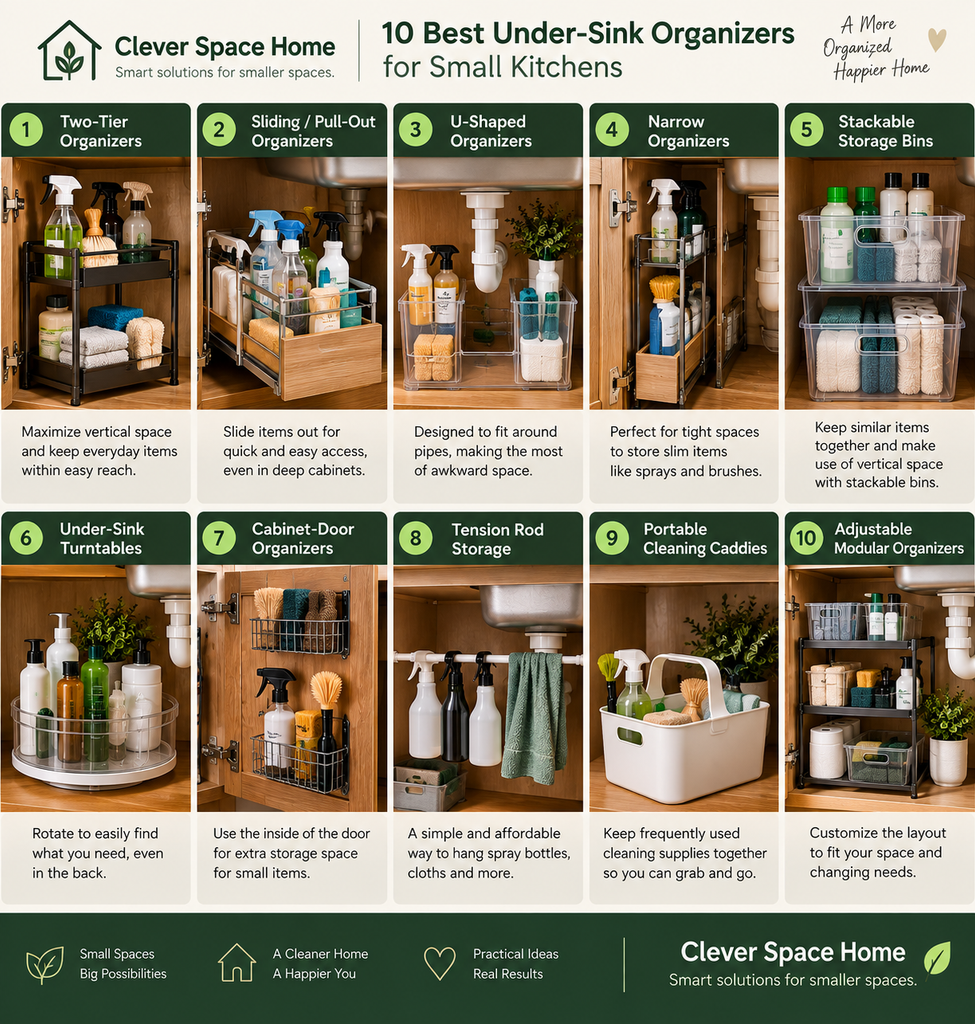
6. Under-Sink Turntables
A turntable or Lazy Susan can be surprisingly useful under the sink when the cabinet has an open corner or clear section.
Instead of moving several bottles to reach one at the back, rotate the turntable until the item you need comes forward.
This works particularly well for bottles of similar height.
Best for
Turntables can work well for:
- cleaning sprays
- dishwashing liquids
- specialty cleaners
- frequently used bottles
- awkward cabinet corners
Choose a turntable with a raised edge so bottles are less likely to fall when it rotates.
Also make sure taller spray bottles can rotate without hitting the sink basin, pipes, or cabinet walls.
Turntables are less useful when plumbing passes directly through the area where the organizer needs to rotate.
Product option: The Copco 12-Inch Non-Skid Lazy Susan Turntable is a simple option for keeping frequently used bottles accessible under the sink. Its 12-inch rotating platform has a raised edge to help contain items as it turns, while the non-skid design can help keep bottles in place. Because a turntable needs clear space to rotate, measure the available area carefully and check for interference from pipes, the sink basin, and cabinet walls.
Check the Copco 12-Inch Lazy Susan Turntable on Amazon → (paid link)
7. Cabinet-Door Organizers
The inside of the cabinet doors is often completely unused.
A shallow door-mounted organizer can provide convenient storage for lightweight supplies without taking space from the cabinet floor.
Possible items include:
- sponges
- cleaning cloths
- gloves
- dishwasher tablets
- small brushes
- trash-bag rolls
Best for
Door organizers are particularly useful when:
- cabinet-floor space is limited
- you have several small lightweight supplies
- frequently used items need quick access
- the cabinet doors have enough clearance
Before installing one, close the cabinet slowly and check what occupies the space immediately behind the door.
A basket attached to the door may collide with bottles, pipes, shelves, or another organizer inside.
Avoid overloading cabinet doors with heavy products.
Product option: The MZYIWUU 2-Pack Clear Cabinet Door Organizer provides shallow storage for smaller, lightweight supplies on the inside of a cabinet door. Each organizer is approximately 3.3 inches deep, helping preserve cabinet-floor space while keeping frequently used items visible and accessible. The organizers mount using adhesive hooks, so check that your cabinet surface is suitable for adhesive mounting and make sure the baskets are securely attached before loading them. Also confirm that the approximately 3.3-inch depth will clear pipes, bottles, shelves, and other organizers when the door closes.
Check the MZYIWUU Cabinet Door Organizer on Amazon → (paid link)
8. Tension Rod Storage
A tension rod can create a simple hanging zone for certain spray bottles.
The bottle triggers can rest over the rod, leaving some floor space available underneath.
This can be useful when several spray cleaners would otherwise occupy a large section of the cabinet floor.
Best for
A tension rod may work when:
- the cabinet has strong opposing side surfaces
- several spray bottles are stored under the sink
- there is enough horizontal clearance
- plumbing does not interfere with the rod
However, this solution is not suitable for every cabinet.
Do not position the rod where it restricts access to plumbing or creates pressure against vulnerable cabinet surfaces.
Also avoid hanging excessive weight from it.
The purpose is to create a small additional storage zone, not to support the entire contents of the cabinet.
9. Portable Cleaning Caddies
Sometimes the most useful organizer is one that can leave the cabinet.
A portable cleaning caddy keeps frequently used cleaning supplies together and allows them to be carried to another part of the home.
Instead of storing several bottles individually, you create one removable cleaning zone.
Best for
A caddy works especially well for:
- multipurpose cleaning supplies
- gloves and cloths
- sprays used throughout the home
- households that frequently move cleaning products between rooms
Choose a caddy that fits comfortably through the cabinet opening and has a sturdy handle.
Avoid making it excessively heavy.
Keeping only frequently used products in the caddy makes it easier to lift and prevents it from becoming another cluttered container.
Product option: The ALINK Large Plastic Cleaning Caddy is a portable option for keeping frequently used cleaning supplies together under the sink. Its built-in handle makes it easy to carry supplies from room to room, while the open design can accommodate different bottle sizes. At approximately 16.5 inches wide, it requires more cabinet-floor space than some compact organizers, so measure the cabinet opening and available space before choosing it. It is best suited to everyday cleaning supplies rather than being overloaded with unusually heavy items.
Check the ALINK Large Cleaning Caddy on Amazon → (paid link)
10. Adjustable Modular Under-Sink Organizers
Under-sink cabinets vary considerably, so adjustable organizers can offer more flexibility than fixed shelving.
Some systems allow shelf heights, widths, basket positions, or individual components to be changed.
This can help the organizer work around plumbing rather than forcing the plumbing to fit around the organizer.
Best for
Adjustable systems are useful when:
- the cabinet has an unusual layout
- plumbing occupies several areas
- storage needs may change
- you want to combine different organizer types
- fixed shelves waste too much space
The key advantage is flexibility.
However, more adjustable components do not automatically make an organizer better.
A simple organizer that fits properly and remains easy to use is preferable to a complicated system that fills every inch but makes supplies difficult to access.
How to Choose the Best Under Sink Organizers for Small Kitchens
The most effective organizer depends on the particular problem inside your cabinet.
Instead of beginning with a product, begin with the storage problem.
If bottles disappear at the back
Consider a pull-out organizer.
Bringing the contents forward can make a deep cabinet much easier to use.
If plumbing occupies the center
Consider U-shaped or narrow organizers that can work around the pipes.
If vertical space is being wasted
Consider a two-tier organizer or carefully positioned stackable bins.
If small supplies are scattered everywhere
Use bins, shallow baskets, or cabinet-door storage to create categories.
If you have many spray bottles
A turntable, pull-out organizer, caddy, or carefully installed tension rod may improve access.
If the cabinet has an unusual layout
An adjustable modular system may provide the flexibility you need.
The goal is not to install as many organizers as possible.
It is to make frequently used supplies visible, accessible, and easy to return to their proper place.
Don’t Forget Leak Protection
Organization should not make it harder to notice water problems. The U.S. Environmental Protection Agency’s guidance on kitchen cabinets notes that leaking pipes under a kitchen sink can contribute to mold growth, which is another reason to keep plumbing visible and address leaks promptly.
Under-sink cabinets contain plumbing connections, so occasional leaks or moisture problems are possible.
Avoid packing the cabinet so tightly that you cannot see the floor or inspect the plumbing.
A waterproof or water-resistant cabinet liner can make small spills easier to clean and may help protect the cabinet surface, although it should never be treated as a substitute for repairing a leak.
Periodically remove stored items and check for:
- moisture
- dripping connections
- staining
- swelling
- odors
- signs of mold or mildew
If you discover an active plumbing leak, address the source rather than simply reorganizing around it.
Avoid Storing Too Much Under the Sink
A well-organized cabinet does not need to be completely full.
In fact, leaving some open space can make the cabinet easier to maintain.
Start by removing products that are:
- empty
- expired where applicable
- rarely used
- duplicated unnecessarily
- stored elsewhere more logically
Then group the remaining supplies by purpose.
If the rest of your kitchen also feels crowded, our guide on how to organize kitchen cabinets in a small kitchen explains how to create storage zones throughout the kitchen rather than forcing everything into one cabinet.
Keep Everyday Supplies Near the Front
Storage priority should generally follow frequency of use.
Products used every day or every week should be easy to reach.
Backup supplies and rarely used products can occupy less convenient areas.
For example, dishwasher tablets and dishwashing supplies may belong near the front, while replacement sponges or unopened refills can be stored farther back or on an upper tier.
This simple approach prevents frequently used items from constantly disturbing the rest of the cabinet.
Keep the Counter From Becoming Backup Storage
An overcrowded under-sink cabinet can cause cleaning supplies and other items to migrate onto the countertop.
That solves one storage problem by creating another.
If countertop clutter is also becoming an issue, our guide on how to organize a small kitchen counter without clutter explains how to protect valuable preparation space while keeping everyday essentials accessible.
Under-sink organization should support the rest of the kitchen rather than simply moving clutter from one surface to another.
Build an Under-Sink System You Can Maintain
The best organization system is not necessarily the one that looks most impressive immediately after installation.
It is the one that still works several months later.
Give each category a predictable location.
For example:
- Front zone: everyday dishwashing supplies
- Side zone: cleaning sprays
- Upper tier: small backup products
- Door storage: lightweight frequently used items
- Back zone: occasional-use supplies
The exact arrangement will depend on your cabinet.
What matters is that household members can understand where things belong without having to reorganize the cabinet every week.
Frequently Asked Questions
What type of organizer is best under a kitchen sink?
There is no single organizer that works for every under-sink cabinet. Pull-out organizers are useful for deep storage, two-tier organizers make use of vertical space, U-shaped systems can work around central plumbing, and narrow organizers can fit beside pipes or disposal units. Measure your cabinet and identify the main storage problem before choosing one.
How do I organize under the sink when pipes are in the way?
Treat the plumbing as a fixed boundary and organize around it. Measure the open areas on each side of the pipes and consider narrow, U-shaped, modular, or independently positioned organizers rather than one large shelf.
Are pull-out organizers good under the kitchen sink?
They can be very useful in deep cabinets because they bring items at the back toward the cabinet opening. However, they need enough clearance to slide without hitting pipes, hinges, or the cabinet frame.
What should I store under my kitchen sink?
Many households use the area for dishwashing products, cleaning supplies, sponges, brushes, cloths, trash bags, and similar household essentials. What belongs there depends on your household and available storage, but items should be kept organized and away from plumbing connections where possible.
How can I maximize space under a small kitchen sink?
Use vertical space where possible, choose organizers that fit around plumbing, make use of cabinet-door storage for lightweight items, and keep frequently used supplies accessible. Removing unnecessary or duplicate products can also create more useful space than simply adding additional organizers.
Should I use clear bins under the sink?
Clear bins can be useful because they make smaller items easier to identify without opening every container. Open-front bins may be even more convenient for frequently used supplies. The best choice depends on what you store and how often you need to access it.
Final Thoughts
The best under-sink organizers for small kitchens are the ones that solve the specific limitations of your cabinet.
For some kitchens, that may be a two-tier pull-out system. For others, narrow organizers positioned around plumbing, a simple turntable, cabinet-door storage, or a portable cleaning caddy may work better.
Measure first, identify the obstacles, and decide which supplies genuinely need to stay under the sink.
Then choose organizers that improve visibility and access without blocking plumbing or overcrowding the cabinet.
A small under-sink cabinet does not need to hold everything. It simply needs to make the space it has work efficiently.
2 thoughts on “Best Under-Sink Organizers for Small Kitchens: 10 Smart Storage Ideas”
Comments are closed.