

Disclosure: This post contains affiliate links. If you purchase through these links, we may earn a commission at no additional cost to you.
Spice jars may be small, but they can create a surprising amount of clutter in a small kitchen. Bottles get pushed behind one another, duplicate spices accumulate, labels become difficult to see, and valuable cabinet or countertop space can quickly disappear.
The problem is usually not the number of spices alone. It is how they are stored.
A good spice organization system makes frequently used seasonings easy to see, reach, and return to the right place. In a compact kitchen, it should also make efficient use of vertical space, narrow gaps, cabinet doors, drawers, or other areas that might otherwise be wasted.
The best spice organizers for small kitchens are therefore not simply decorative racks. They help make limited storage space more functional while keeping spices convenient for everyday cooking.
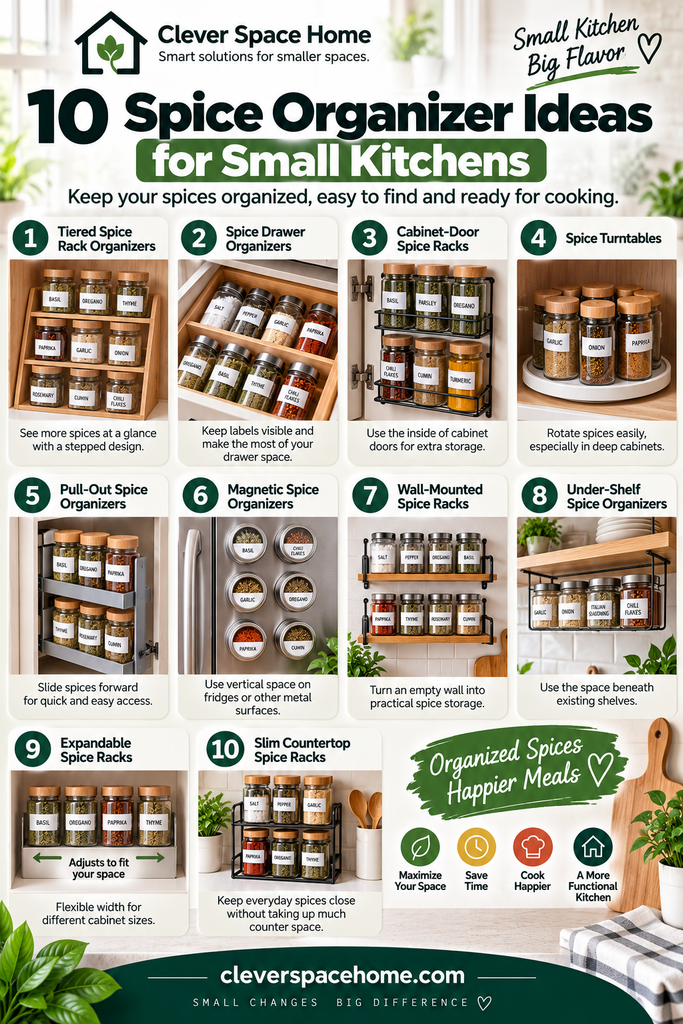
Below are 10 practical spice organizer ideas for cabinets, drawers, countertops, walls, and other small-kitchen storage areas.
Table of Contents
Before Choosing a Spice Organizer, Check Your Available Space
Start by deciding where your spices should live.
Measure the usable width, depth, and height of the cabinet, drawer, shelf, wall area, or countertop space you plan to use.
Then look at the spice containers themselves.
If your collection includes jars of different heights and shapes, an organizer designed around identical containers may not use space efficiently. If most jars are similar, a more structured organizer can work well.
Also think about accessibility. An organizer may hold many jars, but that does not necessarily make it convenient if several bottles need to be removed every time you need one spice.
The goal is to make your most frequently used seasonings visible and easy to reach while using as little valuable kitchen space as practical. If cabinet storage is your main challenge, these best cabinet organizers for small kitchens can also help you make better use of limited shelf space.
1. Tiered Spice Rack Organizers
Tiered spice racks arrange jars at different heights so labels are easier to see.
They are particularly useful inside cabinets where spice jars would otherwise sit in several rows, causing bottles at the back to disappear from view.
A stepped design can make a relatively small cabinet shelf easier to use without requiring a complicated installation.
Best for:
Standard kitchen cabinets with enough vertical clearance.
Small-kitchen tip:
Place taller containers toward the back and shorter jars toward the front when possible. Before buying, measure the combined height of the organizer and your tallest spice jar.
Recommended Option: Oizeir Acrylic 3-Tier Cabinet Organizer
The Oizeir Acrylic 3-Tier Cabinet Organizer creates stepped storage so spice jars in the back are easier to see and reach. Its clear design keeps the cabinet looking visually open while allowing you to organize several rows of spices without hiding smaller jars behind larger ones. Measure the available cabinet width and depth before choosing a tiered organizer.
Check the Oizeir Acrylic 3-Tier Cabinet Organizer on Amazon → (paid link)
2. Spice Drawer Organizers
A drawer can become an efficient spice-storage area when jars are arranged so their labels remain visible.
Some drawer organizers hold bottles at an angle, while others use inserts or dividers to prevent jars from rolling around.
Moving spices into a drawer can also free cabinet or countertop space for other kitchen essentials. For more ways to use limited drawer space efficiently, see our guide to the best drawer organizers for small kitchens.
Best for:
Shallow or medium-depth drawers near the food-preparation area.
Small-kitchen tip:
Measure drawer height carefully. A jar that fits horizontally may still prevent the drawer from closing if the organizer raises it too high.
Recommended Option: Elvathor Acrylic Spice Drawer Organizer
The Elvathor Acrylic Spice Drawer Organizer provides angled, tiered storage that keeps spice labels easier to see when the drawer is opened. Storing jars horizontally in a dedicated drawer can also free cabinet and countertop space, making this approach particularly useful in compact kitchens. Check the internal dimensions of your drawer and the size of your spice jars before buying.
Check the Elvathor Acrylic Spice Drawer Organizer on Amazon → (paid link)
3. Cabinet-Door Spice Racks
The inside of a cabinet door is often overlooked storage space.
A slim spice rack mounted or attached to the door can hold frequently used seasonings without taking up the main cabinet shelf.
This approach can be particularly useful in kitchens where cabinet shelves are already crowded with food, dishes, or cookware.
Best for:
Cabinet doors with enough interior clearance.
Small-kitchen tip:
Close the cabinet slowly after installation to make sure the organizer and spice jars do not collide with shelves or items stored inside.
Recommended Option: Bunoxea Wall-Mounted Spice Rack Organizer
The Bunoxea Spice Rack uses vertical space to keep spice jars organized without taking up a cabinet shelf or countertop area. Depending on your setup, this style of organizer can make use of an otherwise underused wall or suitable cabinet-door area while keeping frequently used seasonings within easy reach. Check the available mounting space and door clearance before installation.
Check the Bunoxea Wall-Mounted Spice Rack Organizer on Amazon → (paid link)
4. Spice Turntables
A turntable, sometimes called a lazy Susan, allows spice jars to rotate toward the front instead of being stored in inaccessible rows.
This can work especially well in deeper cabinets where reaching items at the back is difficult.
Turntables are also flexible because they can hold bottles of different shapes and sizes.
Best for:
Deep shelves, corner cabinets, and mixed-size spice collections.
Small-kitchen tip:
Avoid overloading the turntable. Leaving enough room between containers makes it easier to rotate and remove individual jars.
Recommended Option: Spartan Clear Lazy Susan Turntable Organizer
A rotating organizer can make spices stored toward the back of a cabinet much easier to reach. The Spartan clear turntable lets you rotate the organizer instead of moving several jars out of the way to reach one at the back. This can work especially well in deeper cabinets where visibility and accessibility are common problems.
Check the Spartan Clear Lazy Susan Organizer on Amazon → (paid link)
5. Pull-Out Spice Organizers
Pull-out organizers allow an entire group of spice jars to slide toward you.
Instead of reaching behind the front row of bottles, you can access items stored deeper inside a cabinet.
Some designs are narrow enough to fit beside other cabinet contents, while larger systems can use most of a shelf.
Best for:
Deep cabinets where spices frequently disappear toward the back.
Small-kitchen tip:
Measure both the organizer and the cabinet opening. Hinges, cabinet frames, or door hardware can reduce the usable width.
Recommended Option: Mystozer Pull-Out Spice Rack Organizer
The Mystozer Pull-Out Spice Rack uses a narrow sliding design to make spices easier to access inside a cabinet. Instead of reaching past jars at the front, the organizer can be pulled outward to provide better access to items stored farther back. Its narrow footprint can be particularly useful when working with limited cabinet space, but carefully measure the available cabinet dimensions before ordering.
Check the Mystozer Pull-Out Spice Rack Organizer on Amazon → (paid link)
6. Magnetic Spice Organizers
Magnetic spice storage can use vertical surfaces instead of cabinet or countertop space.
Depending on the system, magnetic containers or racks may attach to a suitable refrigerator side or another compatible metal surface.
This can be useful when traditional storage areas are limited.
Best for:
Kitchens with an appropriate unused magnetic surface.
Small-kitchen tip:
Keep containers away from areas where they could be knocked off easily, and make sure the storage system is designed to securely support the intended jars.
Recommended Option: Sevenblue Magnetic Spice Rack
The Sevenblue Magnetic Spice Rack turns an available magnetic surface, such as the side of a compatible refrigerator, into additional vertical storage. This can free valuable cabinet and countertop space while keeping frequently used spices accessible. Before buying, confirm that the intended surface is magnetic and that there is enough clearance around the refrigerator or appliance.
Check the Sevenblue Magnetic Spice Rack on Amazon → (paid link)
7. Wall-Mounted Spice Racks
An unused section of wall can become practical storage with a slim spice rack.
Wall-mounted organizers keep seasonings visible and can free space inside cabinets and drawers.
They can work particularly well near a food-preparation area, provided the location does not expose spices to excessive heat, moisture, or direct sunlight.
Best for:
Small kitchens with limited cabinets but available wall space.
Small-kitchen tip:
Choose a location that is convenient for cooking but away from the direct heat of the stove.
8. Under-Shelf Spice Organizers
Under-shelf organizers use the unused space directly beneath an existing cabinet shelf.
Depending on the design, the organizer may slide onto the shelf or attach underneath it.
This allows the main shelf surface to remain available for other items while creating a separate storage area for smaller spice containers.
Under-shelf storage is one of several vertical-space solutions covered in our guide to the best kitchen organizers for small kitchens.
Best for:
Cabinets with unused vertical space between shelves.
Small-kitchen tip:
Check that the organizer will not interfere with items stored on the shelf below.
9. Expandable Spice Racks
Expandable organizers can adjust to fit different shelf widths.
This flexibility is useful in small kitchens because cabinet dimensions vary considerably, and a fixed organizer may leave awkward unused gaps.
Expandable racks can also adapt if your spice collection grows or if you later move the organizer to another cabinet.
Best for:
Cabinets where a customizable width is useful.
Small-kitchen tip:
Do not automatically expand the rack to fill the entire shelf. Leave room for other items if that creates a more practical storage arrangement.
10. Slim Countertop Spice Racks
Not every spice collection needs to be hidden inside a cabinet.
A narrow countertop rack can keep frequently used seasonings close to the cooking or food-preparation area without occupying a large amount of work surface.
Vertical or multi-level designs can make better use of a small footprint. If keeping work surfaces clear is a priority, our guide on how to organize a small kitchen counter without clutter covers additional ways to protect valuable countertop space.
Best for:
Everyday seasonings that are used frequently.
Small-kitchen tip:
Keep only your most-used spices on the countertop. Store occasional or specialty seasonings elsewhere to prevent the rack from becoming cluttered.
How to Choose the Best Spice Organizers for Small Kitchens
The best spice organizers for small kitchens should fit both the available storage area and the way you cook.
A large spice collection may benefit from a drawer, tiered cabinet rack, or pull-out system. A smaller collection may work better on a turntable or narrow rack.
Consider visibility as well as capacity.
An organizer that technically holds 40 jars is not necessarily useful if half of the labels are hidden.
Also consider whether your spice collection is likely to change. Adjustable, expandable, and flexible organizers can be useful if you regularly add or replace seasonings.
The right solution should make spices easier to use rather than simply fitting more containers into the same space.
Keep Frequently Used Spices Easy to Reach
Your most frequently used seasonings deserve the most convenient storage positions.
Salt, pepper, garlic powder, paprika, herbs, or whatever you regularly use should generally be easier to access than specialty spices used only occasionally.
This does not mean everything needs to sit beside the stove.
Instead, arrange the organizer so your everyday spices require the least searching and movement.
Organize Spices by a System You Can Maintain
There is no single correct way to arrange spices.
You might organize them:
- Alphabetically
- By cuisine
- By frequency of use
- By type, such as herbs, baking spices, or savory seasonings
Alphabetical storage can make a large collection easier to search, while frequency-based storage may be faster for everyday cooking.
Choose the system that feels natural enough that you will continue using it.
Avoid Buying Matching Jars Just for Appearance
Uniform spice jars can create a clean appearance, but transferring every seasoning into matching containers is not necessary for effective organization.
It also adds another maintenance step because jars need to be refilled and accurately labeled.
If matching containers help your particular storage system, they can be useful. But if your existing containers already fit the organizer and remain easy to identify, replacing them may provide little practical benefit.
Function should come before appearance.
Keep Spices Away From Excessive Heat and Moisture
Convenience matters, but storage conditions matter too.
Avoid placing spices where they are repeatedly exposed to excessive heat, steam, moisture, or strong direct sunlight.
A rack directly above a hot cooking surface may seem convenient but may not be the best long-term storage location.
Choose a storage area that keeps seasonings accessible while protecting them from unnecessary environmental exposure.
For additional guidance on storing herbs and spices, the National Center for Home Food Preservation provides recommendations for maintaining the quality of dried foods and seasonings.
Check Your Spice Collection Regularly
Even an excellent organizer becomes cluttered if unused containers continue accumulating.
Periodically look through your collection for duplicate bottles, nearly empty containers, damaged packaging, or seasonings you no longer use.
This also gives you an opportunity to check product dates and quality according to the manufacturer’s guidance.
Reducing unnecessary containers may solve part of the storage problem before you buy a larger organizer.
Use Labels Only When They Improve Visibility
Labels can be helpful when original packaging is difficult to read or when spices are transferred into reusable containers.
But excessive labeling can create unnecessary work.
If the manufacturer’s label is already clear and visible, there may be no reason to replace it.
For transferred spices, make sure labels clearly identify the contents and include any information you need to retain from the original packaging.
Build Your Spice Storage System Gradually
You do not need to redesign your entire spice collection in one day.
Start by removing everything from the current storage area and identifying what you actually use.
Group the remaining spices, measure the available storage area, and then decide which organizer type solves the main problem.
After using the new system for a while, you may discover that you need a second organizer—or that you need less storage than expected.
This approach reduces the chance of buying several organizers that do not fit your actual kitchen habits.
Frequently Asked Questions
What is the best way to organize spices in a small kitchen?
Choose one dedicated storage area and arrange spices so labels are visible and frequently used seasonings are easy to reach. Depending on your kitchen, a drawer organizer, tiered rack, turntable, cabinet-door rack, or wall-mounted system may work well.
Is it better to store spices in a drawer or cabinet?
Both can work. Drawers can make labels easy to see, while cabinets provide more options for tiered, rotating, expandable, and pull-out organizers. The better choice depends on your available space and jar dimensions.
Are spice racks worth using in small kitchens?
A well-sized spice rack can improve visibility and reduce clutter, particularly when bottles are currently scattered across several shelves or countertops. The rack should solve a specific storage problem rather than simply adding another container.
Can spices be stored on the countertop?
Yes, particularly frequently used spices, but avoid locations exposed to excessive heat, moisture, steam, or direct sunlight. A slim vertical rack can minimize the amount of counter space used.
How do I organize a large spice collection in limited space?
Start by removing duplicates and seasonings you no longer use. Then consider storage systems that improve visibility and use vertical or hidden space efficiently, such as drawer inserts, tiered racks, cabinet-door organizers, pull-outs, or expandable systems.
Final Thoughts
The best spice organizers for small kitchens make seasonings easier to see and reach without consuming more storage space than necessary.
Tiered racks, drawer inserts, cabinet-door organizers, turntables, pull-outs, magnetic storage, wall racks, under-shelf systems, expandable organizers, and slim countertop racks each solve different space problems.
Start with your available storage area rather than the organizer itself.
Measure carefully, identify the spices you use most often, and choose a solution that fits naturally into your cooking routine.
A simple, well-planned spice organization system can reduce clutter and make even a small kitchen feel easier to use.
4 thoughts on “Best Spice Organizers for Small Kitchens: 10 Space-Saving Ideas”
Comments are closed.