
Disclosure: This post contains affiliate links. If you purchase through these links, we may earn a commission at no additional cost to you.
Choosing the best cabinet organizers for small kitchens can make a surprising difference when storage space is limited. Small cabinets often become crowded quickly, making it difficult to reach cookware, dishes, food containers, cleaning supplies, and everyday kitchen essentials.
The problem is not always a lack of cabinet space. In many small kitchens, a significant amount of available space simply goes unused. Tall shelves may leave empty vertical space above short items, deep cabinets can hide supplies at the back, and awkward corners may be difficult to access.
The right cabinet organizers can help turn those unused areas into practical storage. Instead of trying to fit more things randomly into each cabinet, organizers allow you to divide the available space into useful zones.
However, not every organizer works in every kitchen. Cabinet dimensions, shelf spacing, plumbing, hinges, cookware sizes, and the items you use most frequently should all influence what you choose.
Below are 12 practical cabinet organizer types that can help maximize storage and make a small kitchen easier to use.
Table of Contents
Before Buying Cabinet Organizers, Measure Your Space
Before ordering any cabinet organizer, measure the inside of the cabinet carefully. If you want to organize the cabinet itself before choosing accessories, start with our guide on how to organize kitchen cabinets in a small kitchen.
Measure the cabinet’s width, depth, and usable height rather than relying only on its exterior dimensions. The cabinet opening may be narrower than the interior because of the frame, hinges, or doors.
Also check for obstacles such as:
- Door hinges
- Shelf supports
- Plumbing
- Garbage disposal equipment
- Pipes
- Cabinet frames
- Existing fixed shelves
If you are considering a sliding organizer, make sure there is enough clearance for it to move through the cabinet opening. The Home Depot’s guidance on installing pull-out cabinet organizers also emphasizes measuring the cabinet opening and checking clearance before installation.
It is also worth measuring the items you intend to store. A shelf riser may fit perfectly inside a cabinet but still be too short for your dinner plates or too narrow for your cookware.
A few minutes spent measuring can prevent buying an organizer that looks useful online but does not work in your actual cabinet.
1. Shelf Risers
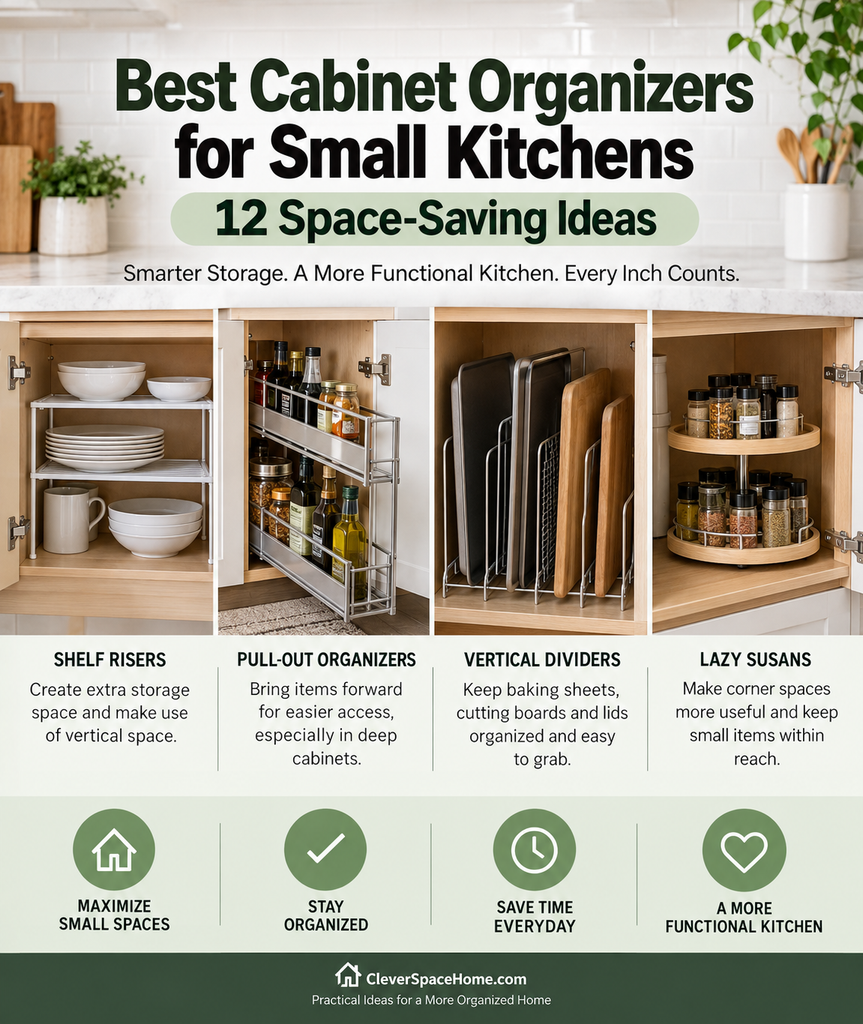
Shelf risers are one of the simplest ways to create additional storage inside a kitchen cabinet.
A typical cabinet shelf may have plenty of unused vertical space above shorter items such as bowls, mugs, plates, or food containers. A shelf riser creates another storage level without requiring permanent changes to the cabinet.
For example, you could store dinner plates underneath the riser and smaller bowls above it. In another cabinet, mugs could sit underneath while glasses are stored on top.
Shelf risers can work particularly well for:
- Plates and bowls
- Mugs and glasses
- Canned food
- Food-storage containers
- Small pantry items
They are especially useful when cabinet shelves cannot easily be repositioned.
Before choosing one, measure both the available height and the items you want to place underneath it.
Product option: The SONGMICS Cabinet Organizer Shelf Set provides two separate risers that can create additional storage levels inside a cabinet. The shelves can be arranged in different configurations depending on the available space, making them useful for items such as plates, bowls, mugs, or small pantry products. Measure the cabinet height and shelf depth before choosing a configuration.
Check the SONGMICS Cabinet Organizer Shelf Set on Amazon → (paid link)
2. Pull-Out Cabinet Organizers
Deep cabinets can provide plenty of storage but still be frustrating to use because items at the back are difficult to reach.
A pull-out cabinet organizer solves this problem by bringing stored items toward you. Pull-out systems are also among the most useful options in our guide to the best kitchen organizers for small kitchens.
Instead of removing several bottles, containers, or pans to reach something in the back, you can slide the organizer forward and see much more of the cabinet contents at once.
Pull-out organizers can be useful for storing:
- Cooking oils
- Sauces
- Cleaning products
- Pots and pans
- Food containers
- Small appliances
Some models sit freely inside the cabinet, while others attach to the cabinet base.
For a small kitchen, pay particular attention to the organizer’s usable width. Cabinet hinges and frames can reduce the clearance available for sliding mechanisms.
3. Stackable Cabinet Shelves
Stackable shelves provide another way to take advantage of unused vertical cabinet space.
Unlike a single shelf riser, stackable organizers can sometimes be combined to create several storage levels.
They can work well for smaller items that would otherwise become piled together.
For example, one level might hold bowls while another stores small plates. In a food cabinet, different levels could separate canned goods, snacks, or baking ingredients.
The key is to avoid creating so many levels that items become difficult to remove.
In a small kitchen, accessibility is just as important as maximizing capacity.
4. Vertical Dividers for Baking Sheets and Cutting Boards
Baking sheets, cutting boards, trays, and muffin pans can be awkward to store horizontally.
When several are stacked on top of one another, removing the item at the bottom often means lifting everything above it.
Vertical cabinet dividers allow these flat kitchen items to stand upright instead.
Individual sections can separate:
- Cutting boards
- Baking sheets
- Serving trays
- Muffin pans
- Cooling racks
- Large lids
This arrangement makes it easier to pull out one item without disturbing the rest.
Vertical dividers are particularly useful in narrow cabinets where conventional shelves may not provide much practical storage.
Product option: The YouCopia StoreMore Adjustable Bakeware Rack uses movable dividers to separate items such as baking sheets, cutting boards, trays, and muffin pans. The adjustable spacing can be useful when the items stored together have different thicknesses, while vertical storage makes individual pieces easier to remove. Check the available cabinet space and the dimensions of your largest bakeware before buying.
Check the YouCopia StoreMore Bakeware Rack on Amazon → (paid link)
5. Cabinet-Door Organizers
The inside of a cabinet door is often overlooked storage space.
A shallow door-mounted organizer can provide room for smaller items without occupying valuable shelf space.
Depending on the cabinet, door organizers may work for:
- Foil and food wrap
- Small cleaning supplies
- Measuring spoons
- Pot lids
- Lightweight cutting boards
- Small packets or kitchen accessories
However, always check clearance before installing one.
The organizer and its contents must fit between the cabinet door and anything stored on the shelves when the door closes.
Avoid placing excessively heavy items on cabinet doors unless the organizer and cabinet hardware are designed to support them.
6. Lazy Susans and Cabinet Turntables
Cabinet corners and deep shelves can make small bottles and containers difficult to reach.
A turntable allows you to rotate stored items instead of reaching behind everything in front.
This can be particularly helpful for:
- Spices
- Sauces
- Oils
- Condiments
- Vitamins
- Small jars
- Baking supplies
Turntables can also help prevent forgotten items from accumulating at the back of a cabinet.
Before buying one, measure the cabinet depth and width carefully. Remember that a round organizer needs enough clearance to rotate without hitting the cabinet walls or other objects.
7. Tiered Cabinet Organizers
When several cans, jars, or spice containers are stored at the same height, items in the back can disappear from view.
A tiered organizer raises the rear rows so that you can see more of what is stored inside the cabinet.
These organizers work especially well for:
- Canned goods
- Spice jars
- Small bottles
- Condiments
- Baking ingredients
Visibility is important in a small kitchen because it reduces the chance of buying duplicates of items you already have.
Tiered storage can therefore improve organization without necessarily increasing the amount of food you keep.
Product option: The INVOCOO Expandable 3-Tier Organizer uses stepped levels to make smaller jars and bottles in the rear rows easier to see. Its expandable design can adapt to different cabinet widths, making it particularly useful for spices, seasonings, and other relatively small containers. Measure the available shelf width and depth, and consider the size of the containers you intend to store before buying.
Check the INVOCOO Expandable 3-Tier Organizer on Amazon → (paid link)
8. Under-Shelf Baskets
The area directly underneath a cabinet shelf is another place where usable space may be wasted.
Under-shelf baskets usually slide onto an existing shelf and create a shallow storage area underneath it.
They can be useful for lightweight items such as:
- Kitchen towels
- Food-storage bags
- Small packets
- Lightweight wraps
- Napkins
- Small accessories
They work best when there is sufficient clearance below the shelf.
Avoid overloading them, particularly if the basket simply hooks or slides onto the shelf rather than being permanently mounted.
9. Corner Cabinet Organizers
Corner cabinets can offer a surprising amount of space, but much of it may be difficult to reach.
Depending on the cabinet design, solutions may include rotating shelves, kidney-shaped trays, pull-out systems, or simple storage bins that make deep areas easier to access.
For renters or anyone avoiding permanent cabinet modifications, removable bins or turntables may be the easiest starting point.
A useful principle for corner cabinets is to avoid storing frequently used items in places that require excessive reaching or moving other objects.
Items used less often can usually occupy the deeper areas.
10. Pot and Pan Organizers
Cookware can consume a large portion of cabinet storage in a small kitchen. For a complete cookware-storage system, see our guide on how to organize pots and pans in a small kitchen.
Traditional stacking works, but it often creates a heavy pile where the pan you need is somewhere near the bottom.
A pot and pan organizer can separate cookware vertically or horizontally so individual pieces are easier to remove.
These organizers may be particularly useful for:
- Frying pans
- Saucepans
- Skillets
- Pot lids
- Cutting boards
Before choosing an organizer, measure your largest cookware pieces as well as the cabinet opening.
Large handles can require considerably more space than the diameter of the pan itself.
Product option: The MUDEELA Expandable Pot and Pan Organizer uses adjustable dividers to separate cookware, lids, cutting boards, and similar kitchen items. Its expandable layout allows the spacing to be adapted to different cookware sizes rather than keeping everything in one stack. Because pan handles and larger cookware can require considerable clearance, measure the usable cabinet space carefully before choosing a configuration.
Check the MUDEELA Pot and Pan Organizer on Amazon → (paid link)
11. Clear Storage Bins
Clear bins can help divide large cabinet shelves into smaller, manageable zones. If your kitchen lacks dedicated food storage, our guide on how to organize a small kitchen without a pantry covers additional ways to create practical storage zones.
Instead of having dozens of unrelated items spread across one shelf, each bin can contain a specific category.
For example, separate bins could be used for:
- Baking supplies
- Snacks
- Breakfast items
- Food-storage accessories
- Cleaning supplies
- Small kitchen tools
Clear containers make it easier to see what is inside without pulling every bin out.
Handles can also be useful in deep cabinets because they allow an entire category of items to be pulled forward at once.
The goal is not to put everything into a container. Use bins where they improve access or prevent small items from spreading across the cabinet.
12. Adjustable and Expandable Cabinet Organizers
Small kitchens often contain cabinets of different widths and heights.
Adjustable organizers can be useful because they allow the storage system to adapt to the available space rather than requiring the cabinet to match a fixed organizer.
Expandable options may include:
- Adjustable shelf risers
- Expandable racks
- Adjustable cookware dividers
- Sliding drawer systems
- Modular storage units
These can be particularly helpful if you expect your storage needs to change over time.
However, check both the minimum and maximum dimensions before buying. An expandable organizer still needs enough clearance for doors, hinges, pipes, and the items stored around it.
How to Choose the Best Cabinet Organizers for Small Kitchens
Choosing the best cabinet organizers for small kitchens is not simply about finding products that hold the most items.
A useful cabinet organizer should make the cabinet easier to use.
Start by identifying the specific problem you are trying to solve.
If items disappear at the back of a deep cabinet, a pull-out organizer may help.
If you have unused vertical space, shelf risers or stackable shelves may be more useful.
If baking sheets are piled horizontally, vertical dividers could solve the problem.
If small bottles become lost in a corner, a turntable may provide easier access.
Matching the organizer to the problem usually produces better results than purchasing organizers first and deciding what to put in them later.
Avoid Filling Every Inch of Cabinet Space
Maximizing storage does not mean eliminating every empty space.
A cabinet packed completely full can actually become harder to use.
You may have more items inside it, but reaching them can require removing several other things first.
Try to leave enough room to:
- See what you own
- Remove items easily
- Return items without rearranging everything
- Clean the cabinet
- Notice spills or leaks
A small amount of open space can make an organized cabinet much more functional.
Keep Everyday Items in the Easiest-to-Reach Areas
Storage location should reflect how often an item is used.
Everyday dishes, glasses, cookware, and ingredients should generally be kept in convenient locations.
Items used occasionally can occupy higher shelves or deeper cabinet areas.
This simple approach reduces unnecessary reaching and prevents frequently used items from constantly disrupting the rest of the cabinet.
Think of your cabinets as having three practical zones:
- Prime zone: easiest to reach and suitable for everyday items.
- Secondary zone: slightly higher, lower, or deeper areas for items used regularly but not every day.
- Occasional zone: harder-to-reach areas for seasonal or infrequently used items.
Organizers become much more effective when combined with this type of storage zoning.
Do Not Organize Items You No Longer Need
Before buying additional organizers, look at what is already inside your cabinets.
Small kitchens can quickly accumulate duplicate utensils, unused mugs, food containers without matching lids, expired ingredients, and appliances that are rarely used.
Adding organizers to store unnecessary items does not solve the underlying space problem.
Remove obvious clutter first.
Then organize what remains.
This can sometimes eliminate the need for an additional organizer altogether.
Keep Similar Items Together
Grouping similar items creates simple storage zones.
Instead of storing food containers in several different cabinets, keep them together when possible.
The same principle can be applied to:
- Baking supplies
- Breakfast foods
- Cooking oils
- Spices
- Drinkware
- Cookware
- Cleaning products
When every category has a predictable location, it becomes easier to find things and easier to put them away.
Organizers should reinforce these zones rather than create unnecessarily complicated systems.
Make Cabinet Storage Easy to Maintain
A cabinet organization system should continue working after the initial cleanup.
If returning an item requires moving three bins, lifting two organizers, and rearranging several other objects, the system may be too complicated.
Simple systems are usually easier to maintain.
Ask yourself:
Can I see what is stored here?
Can I reach it easily?
Can I put it back quickly?
Does the organizer solve a real storage problem?
If the answer is yes, the system is likely to remain useful over time.
Build a Cabinet Organization System One Area at a Time
You do not need to reorganize every kitchen cabinet in one day.
Start with the cabinet causing the most frustration.
Empty it, remove anything unnecessary, measure the available space, and identify the main storage problem.
Then choose the simplest organizer that solves that problem.
Once the first cabinet works well, move to the next one.
This approach has another advantage: you learn which types of organizers actually work in your kitchen before spending money on several products.
Over time, individual improvements can create a much more functional kitchen without requiring a renovation or additional cabinetry.
Frequently Asked Questions
What is the best way to organize deep kitchen cabinets?
Pull-out organizers, handled bins, and turntables can make deep cabinets easier to use because they bring items forward rather than leaving them hidden at the back. Frequently used items should generally remain closer to the front.
How can I add more storage to small kitchen cabinets?
Look first for unused vertical and door space. Shelf risers, stackable shelves, under-shelf baskets, vertical dividers, and cabinet-door organizers can create additional usable storage without adding more cabinets.
Are pull-out cabinet organizers worth it?
They can be particularly useful in deep lower cabinets where reaching items at the back is difficult. Measure the cabinet opening and check hinge clearance before choosing one.
What should I store in upper kitchen cabinets?
Upper cabinets are often suitable for dishes, glasses, food items, and lightweight kitchen supplies. Frequently used items should be kept on shelves that can be reached comfortably, while less-used items can occupy higher shelves.
How do I organize pots and pans in a small cabinet?
Consider vertical or horizontal cookware racks that separate individual pots and pans. If stacking is necessary, keep frequently used cookware near the top and store lids separately when that makes access easier.
Should I use storage bins inside kitchen cabinets?
Bins can be useful for grouping small or related items, especially in deep cabinets. They work best when each bin has a clear purpose rather than being used simply to contain miscellaneous clutter.
Final Thoughts
The best cabinet organizers for small kitchens are the ones that solve specific storage problems while keeping everyday items easy to see, reach, and return.
Shelf risers can make use of vertical space, pull-out organizers can improve deep cabinets, vertical dividers can simplify cookware and baking-sheet storage, and turntables can make awkward corners more accessible.
But organizers alone will not make a kitchen functional.
Start by removing items you no longer need, group similar things together, measure your cabinets carefully, and choose organizers only where they improve accessibility.
A small kitchen does not need perfectly packed cabinets. It needs storage that works efficiently.
By improving one cabinet at a time, you can gradually create a kitchen that feels less cluttered, provides more usable storage, and makes everyday cooking and cleanup easier.
11 thoughts on “Best Cabinet Organizers for Small Kitchens: 12 Space-Saving Ideas”
Comments are closed.