
Disclosure: This post contains affiliate links. If you purchase through these links, we may earn a commission at no additional cost to you.
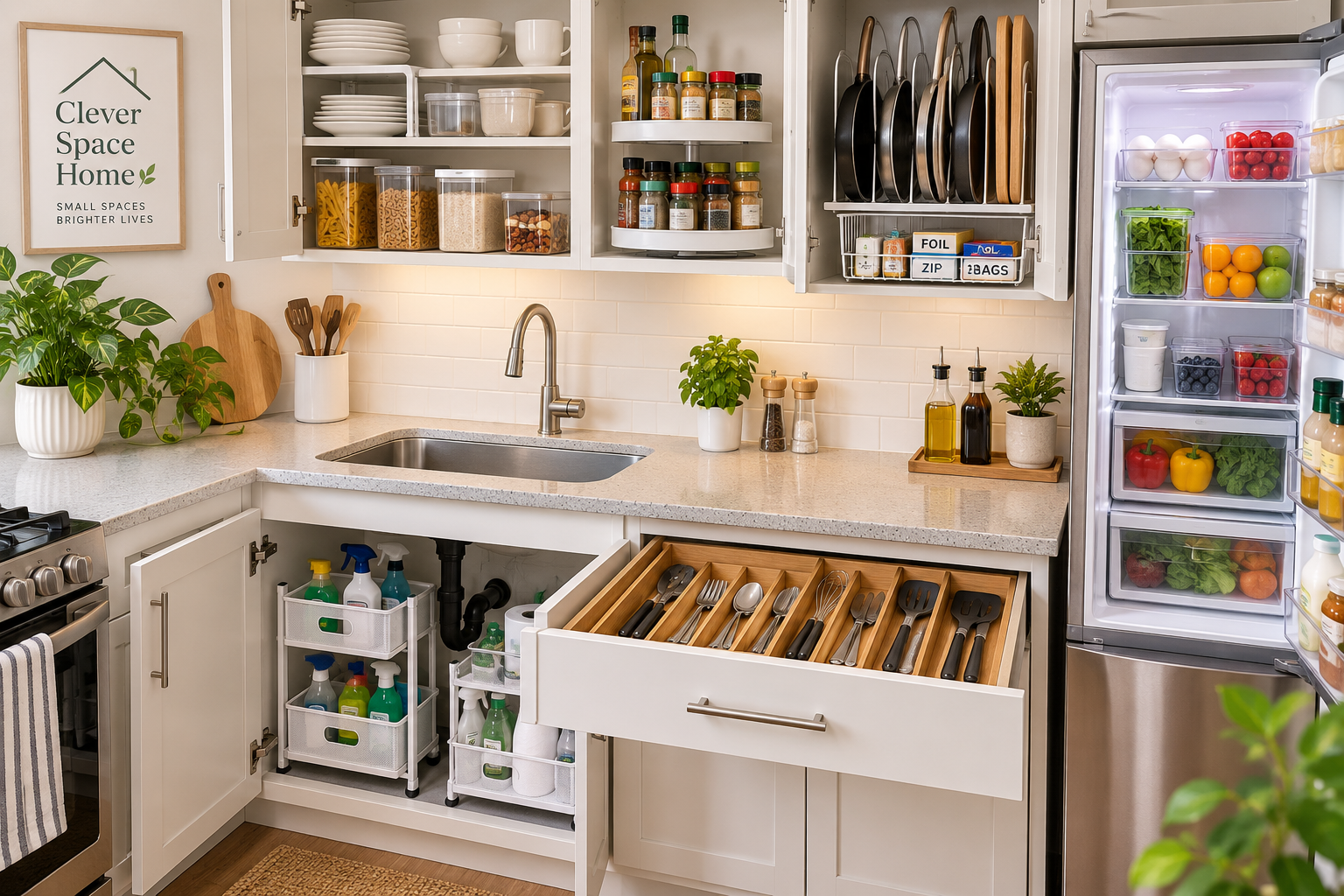
A small kitchen can have enough storage and still feel frustrating to use. The problem is often not the total amount of space available, but how that space is divided, accessed, and organized.
Deep cabinets can hide items at the back. Pots and pans can consume an entire cabinet. Small food packages get lost on shelves, while utensils compete for limited drawer space. Even a reasonably sized countertop can quickly become cluttered when everyday items do not have convenient homes.
The right organizers can help solve these problems without requiring a kitchen renovation.
The best kitchen organizers for small kitchens make existing storage easier to use. They can divide large spaces into smaller zones, take advantage of vertical space, improve access to deep cabinets, and keep frequently used items within easy reach.
Before buying organizers, however, it helps to understand which type solves which problem. An organizer that works beautifully in one kitchen may waste space in another.
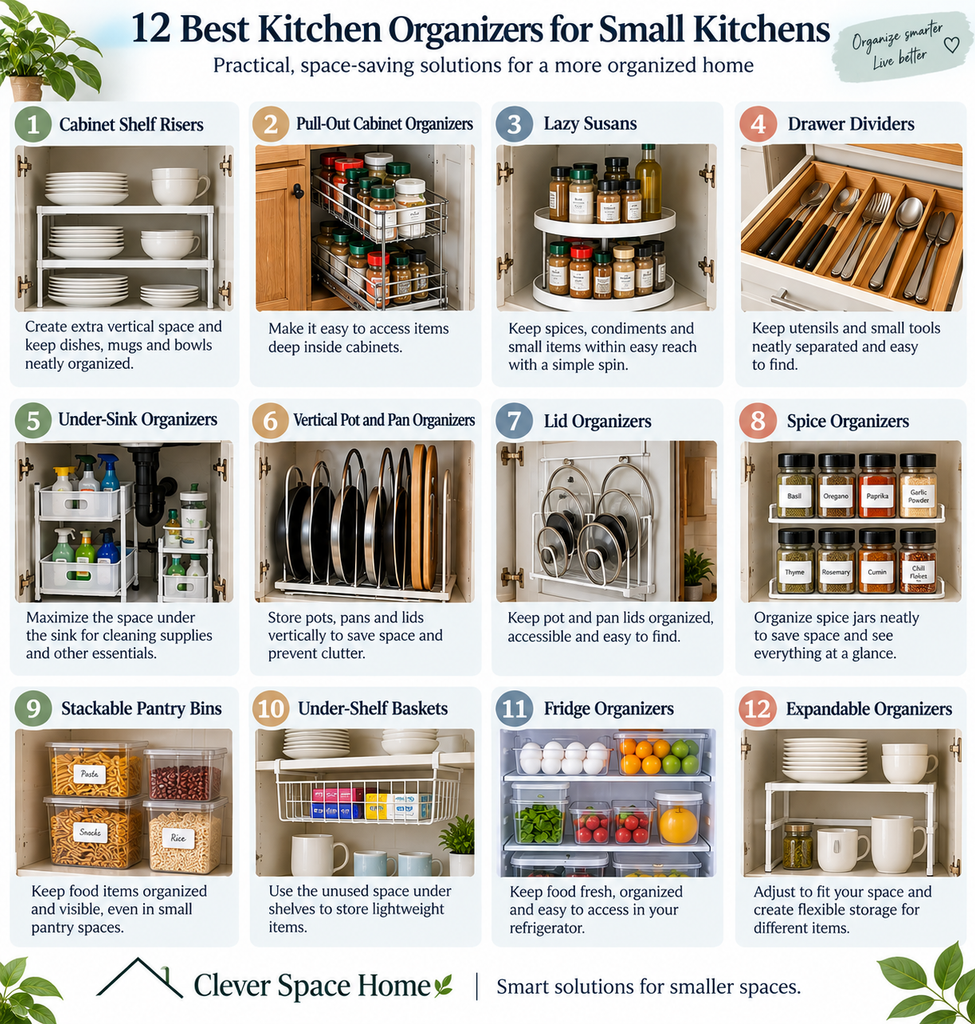
Here are 12 practical organizer types worth considering for a small kitchen, along with guidance on where they work best and what to check before buying.
Table of Contents
Before Buying Kitchen Organizers, Measure Your Space
It is tempting to see an attractive organizer and immediately imagine it inside your kitchen. In a small kitchen, measuring first is especially important.
Measure the width, depth, and usable height of the cabinet, drawer, shelf, or countertop area where the organizer will go.
Do not rely only on the external dimensions of a cabinet. Hinges, plumbing, shelf supports, door frames, disposal units, pipes, and other obstructions can reduce the usable space inside. This matters especially with fitted organizers: The Home Depot’s guidance for a cabinet pull-out organizer recommends checking the cabinet opening from side to side, front to back, and top to bottom while also accounting for obstructions.
For drawers, also check their internal height. An organizer may technically fit the drawer’s width and depth but prevent it from closing once utensils are placed inside.
Think about what you actually want to store before choosing the organizer.
A good rule is:
Identify the storage problem first → measure the available space → choose the organizer.
Not the other way around.
1. Cabinet Shelf Risers
Kitchen cabinets often have more vertical space than the items stored inside them require.
For example, placing a short stack of plates on a tall cabinet shelf leaves a large amount of unused space above the plates.
A shelf riser effectively creates another level.
You could keep dinner plates underneath while storing bowls or smaller dishes above. Shelf risers can also work for mugs, pantry foods and baking supplies.
They are particularly useful when cabinet shelves cannot easily be repositioned.
Best for
Plates, bowls, mugs, canned foods and short pantry containers.
What to check before buying
Measure both the available width and height.
Also consider the height of the items you intend to place underneath the riser. A shelf that creates more levels is not useful if you cannot comfortably remove the items below it.
For more ideas on dividing cabinet space into practical zones, see our guide on how to organize kitchen cabinets in a small kitchen.
Recommended Product: RUILALIFE Expandable Cabinet Organizer Shelf
A shelf riser can make better use of the empty vertical space between cabinet shelves, especially when shorter dishes, bowls, or pantry items leave unused space above them. An expandable design also gives you more flexibility when working with narrow or unusually sized cabinets.
Before buying, measure both the available width and height inside the cabinet. The goal is to create an additional usable level without making items on either level difficult to reach.
Check the RUILALIFE Expandable Cabinet Organizer Shelf on Amazon → (paid link)
2. Expandable Drawer Organizers
A utensil drawer can become messy surprisingly quickly.
Forks, spoons, measuring tools, peelers, scissors and miscellaneous kitchen gadgets often end up sharing the same limited space.
An expandable drawer organizer creates dedicated compartments while adapting to the width of the drawer.
The advantage of an expandable design is that it can use more of the available drawer instead of leaving unused gaps along the sides.
Best for
Cutlery, cooking utensils and small kitchen tools.
What to check before buying
Measure the drawer internally and compare those measurements with both the organizer’s collapsed and fully expanded dimensions.
Think about the length of your larger utensils too. Some organizers are designed mainly for flatware and may not accommodate longer cooking tools.
Avoid filling every compartment simply because it exists. Keeping only the utensils you regularly use usually makes the drawer much easier to maintain.
Recommended Product: YouCopia DrawerFit Expandable & Adjustable Drawer Organizer
An adjustable drawer organizer can help turn a crowded kitchen drawer into defined storage zones without requiring every drawer to have the same dimensions. This is particularly useful in a small kitchen where utensils and everyday tools need to share limited drawer space.
Measure the inside dimensions of the drawer before choosing an organizer, including its usable height. An expandable model is most useful when it can fit securely without preventing the drawer from closing smoothly.
Check the YouCopia DrawerFit Organizer on Amazon → (paid link)
3. Lazy Susans and Turntables
Corners and deep shelves can create an access problem.
Items at the front are easy to reach, while everything behind them slowly disappears from view.
A rotating turntable—or Lazy Susan—brings items from the back toward you without requiring you to remove everything in front.
This can be especially helpful for bottles and jars that would otherwise form several rows.
Best for
Oils, sauces, condiments, spices, jars and frequently used pantry items.
What to check before buying
Measure the diameter of the turntable rather than looking only at the width of the shelf.
If using one inside a cabinet, check that it can rotate freely without hitting the cabinet frame or door.
A raised edge can also help prevent bottles from sliding off while the organizer turns.
4. Pull-Out Cabinet Organizers
Deep lower cabinets often provide plenty of storage volume but poor accessibility.
Items placed near the back may require bending, reaching and removing several other things first.
A pull-out organizer changes how the space is accessed. Instead of reaching into the cabinet, you bring much of the stored contents toward you.
Depending on the design, these organizers can hold cookware, food containers, cleaning products or pantry supplies.
Best for
Deep base cabinets and storage areas where items at the back are difficult to reach.
What to check before buying
This category requires particularly careful measurement.
Check the cabinet opening—not simply the internal cabinet width—because hinges and door frames may reduce the clearance available for the organizer.
Some pull-out systems also require installation with screws or mounting hardware. Check the installation requirements before purchasing.
Renters may prefer freestanding or removable alternatives if permanent modifications are not permitted.
5. Under-Sink Organizers
The cabinet beneath the kitchen sink is one of the most awkward storage areas in many kitchens.
Plumbing divides the cabinet into irregular sections, while cleaning bottles and supplies can quickly create clutter around the pipes.
Under-sink organizers are often designed with this obstacle in mind.
Two-tier shelves, pull-out baskets, narrow bins and modular organizers can help turn the remaining space into practical storage zones.
Best for
Cleaning products, dishwasher supplies, sponges, cloths, trash bags and other sink-related essentials.
What to check before buying
Measure around the plumbing.
Pay attention to the position of the drainpipe, garbage disposal if present, water lines and cabinet hinges.
Do not assume that an organizer will fit simply because its overall dimensions are smaller than the cabinet.
We have a complete guide explaining how to organize under the kitchen sink in a small kitchen, including measuring and creating storage zones around plumbing.
Recommended Product: REALINN L-Shaped Pull-Out Under-Sink Organizer
Under-sink cabinets often lose usable storage space because plumbing blocks the center of the cabinet. An L-shaped organizer can use space around those obstacles while providing separate levels for cleaning supplies and other appropriate items.
Measure around pipes, disposal units, and other plumbing before buying. Also check that a pull-out organizer has enough clearance to move freely once installed.
Check the REALINN L-Shaped Under-Sink Organizer on Amazon → (paid link)
6. Vertical Pot and Pan Organizers
Stacking cookware can save space, but it can also create an annoying daily routine.
If the frying pan you need is underneath three other pans, you have to move the entire stack to reach it.
A vertical cookware rack allows pans, skillets, baking sheets or lids to stand separately.
Instead of lifting several pieces, you can slide out the one you need.
Best for
Frying pans, skillets, baking sheets, cutting boards and some cookware lids.
What to check before buying
Measure the cabinet’s internal height and depth, then compare them with the size of your cookware.
Pay particular attention to handles.
A rack may fit perfectly while the pan handles prevent the cabinet door from closing.
For a more complete cookware system, read our guide on how to organize pots and pans in a small kitchen.
Recommended Product: MUDEELA Expandable Pot, Pan and Lid Organizer
Storing cookware vertically can make individual pans easier to remove without lifting an entire stack. An adjustable rack can also accommodate different cookware sizes while creating defined spaces for pans and lids.
Before choosing one, measure the cabinet’s width, depth, and usable height and compare those measurements with your cookware. Large handles and deep pans may require more clearance than expected.
Check the MUDEELA Pot, Pan and Lid Organizer on Amazon → (paid link)
7. Dedicated Lid Organizers
Lids create a different storage problem from pots and pans.
They are relatively thin, but their handles and different diameters make them difficult to stack neatly.
A dedicated lid organizer keeps them upright or separated into individual slots.
This can turn a pile of loose lids into a narrow, accessible storage zone.
Best for
Pot lids, pan lids and some food-storage-container lids.
What to check before buying
Check the spacing between dividers.
Large handles or knobs may require wider gaps than flat lids.
Also consider whether storing lids vertically inside a cabinet, drawer, or door-mounted system makes the most sense for your kitchen.
Whenever possible, keep lids close to the cookware they belong to.
Recommended Product: DMLBST Pot Lid Organizer
Separating lids from pots and pans can make a crowded cookware cabinet easier to use. A vertical lid organizer keeps individual lids visible and accessible instead of leaving them stacked together or leaning loosely against cookware.
Check the available cabinet space as well as the diameter, handle shape, and thickness of your lids before choosing an organizer.
Check the DMLBST Pot Lid Organizer on Amazon → (paid link)
8. Spice Organizers
Spice containers are small, which sounds ideal for a small kitchen—until dozens of them accumulate.
When jars sit in several rows on a shelf, the ones at the back become difficult to see.
Different organizers solve this in different ways.
Tiered shelves raise the back rows. Turntables rotate jars toward you. Drawer inserts display labels at an angle, while pull-out racks use narrow cabinet spaces.
Best for
Spice jars, seasoning containers and small bottles.
What to check before buying
Choose the organizer based on where you want the spices to live rather than buying the organizer first.
Measure your existing jars as well. Spice containers vary considerably in height and diameter.
Most importantly, keep the system practical for the way you cook. Frequently used seasonings should be the easiest ones to reach.
Recommended Product: Sevenblue Magnetic Spice Rack
A magnetic spice rack can move frequently used seasonings out of crowded cabinets when a suitable magnetic surface is available. This can be particularly useful in a small kitchen because it creates storage without taking up additional counter or cabinet-shelf space.
Before buying, decide exactly where the rack will be installed and check that the surface is suitable for magnetic mounting. Avoid positioning frequently used items where they could interfere with cooking or normal movement.
Check the Sevenblue Magnetic Spice Rack on Amazon → (paid link)
9. Stackable Pantry Bins
A pantry is useful, but it is not essential for organized food storage.
Clear or open-front bins can turn ordinary cabinets, shelves, carts and other available areas into defined food-storage zones.
Instead of mixing packets, snacks and baking ingredients together, bins allow similar items to stay grouped.
Stackable designs can also take advantage of unused vertical space.
Best for
Snacks, packets, baking supplies, breakfast foods and packaged pantry staples.
What to check before buying
Do not buy a large set of matching containers before measuring your shelves and deciding what will actually go inside them.
Check whether stacked bins remain accessible. If you must unstack three containers every time you need something from the bottom one, the system may become inconvenient.
Open-front or pull-out designs can work better for frequently used foods.
If your home lacks dedicated pantry space, our guide on how to organize a small kitchen without a pantry explains how to create food-storage zones elsewhere in the kitchen.
10. Under-Shelf Baskets
The space directly underneath a cabinet shelf often goes unused.
An under-shelf basket attaches or slides onto the shelf above, creating shallow storage underneath it.
This can be useful when a tall shelf contains relatively short items.
Unlike adding another permanent shelf, many under-shelf baskets are removable and require little or no installation.
Best for
Food wraps, lightweight packets, kitchen towels, small containers and other relatively light items.
What to check before buying
Measure the thickness of the shelf as well as the clearance below it.
Make sure the basket will not interfere with the items already stored underneath.
Check the manufacturer’s weight guidance too. These organizers are generally better suited to lighter items than heavy cookware or appliances.
11. Over-the-Door and Cabinet-Door Organizers
Cabinet doors provide another potential storage surface.
Depending on the available clearance, door-mounted organizers can hold lightweight supplies that would otherwise consume shelf or drawer space.
This approach can be particularly useful in very small kitchens where almost every interior surface matters.
Best for
Lightweight cleaning supplies, wraps, small packets, cutting boards or other slim items, depending on the organizer design.
What to check before buying
Close the cabinet mentally—and physically measure the clearance—before installing anything.
The organizer and its contents must not collide with shelves, pipes or items stored inside the cabinet.
Also consider the weight placed on the door. Heavy storage systems may not be appropriate for every cabinet.
12. Refrigerator Storage Bins
Kitchen organization does not stop at the cabinets.
A refrigerator can also become difficult to use when small containers, produce, condiments and packaged foods are scattered across large shelves.
Bins can create categories such as snacks, breakfast items, produce or meal-preparation ingredients.
Pulling out one bin can also make items at the back easier to access.
Best for
Small packaged foods, produce, snacks and grouped refrigerator ingredients.
What to check before buying
Measure refrigerator shelf depth and height carefully.
Avoid filling the refrigerator with containers simply for appearance. The goal is easier access and better visibility, not creating another layer of storage equipment to manage.
Allow appropriate airflow and follow your refrigerator manufacturer’s guidance about where different foods should be stored.
How to Choose the Best Kitchen Organizers for Small Kitchens
You do not need all 12 organizer types.
In fact, buying too many organizers can create a new kind of clutter.
Walk through your kitchen and identify the areas that repeatedly cause frustration.
Maybe pans are difficult to retrieve. Perhaps food disappears at the back of a cabinet. Maybe the under-sink area has no structure, or your countertop has become permanent storage for items that should live elsewhere.
Start with the biggest problem.
Then ask four questions:
- What exactly needs to be stored?
- Where should those items ideally live?
- What are the usable dimensions of that space?
- Would an organizer genuinely improve access or simply add another object?
The best kitchen organizers for small kitchens are not necessarily the most complicated ones. Often, a simple shelf riser, turntable, bin, or vertical rack solves a specific problem more effectively than an elaborate storage system.
Avoid Buying Organizers Before Decluttering
An organizer cannot compensate for keeping too many things in too little space.
Before purchasing new storage products, remove expired food, duplicate utensils you never use, damaged containers, unnecessary packaging, and cookware that no longer serves your needs.
Then group similar items together.
Once you can see what actually needs storage, it becomes much easier to choose the correct organizer and size.
This approach can also save money because you may discover that you need fewer organizers than expected.
Keep Countertop Organizers Selective
Not every organizer belongs inside a cabinet.
A compact utensil holder, small tray, vertical rack, or carefully chosen countertop organizer can make frequently used items easier to reach.
But countertop storage needs stricter limits in a small kitchen.
Every organizer placed on the counter reduces usable preparation space.
Keep only items that genuinely earn their place there.
Our guide on how to organize a small kitchen counter without clutter explains how to decide what should stay out and what should move into storage.
Create a System, Not Just an Organized Photograph
A kitchen can look perfectly organized immediately after new bins and racks are installed and become cluttered again two weeks later.
The difference is whether the organizers form a practical system.
Store items near where they are used.
Keep frequently used things easier to reach than occasional items.
Avoid making everyday items pass through several steps—such as removing a bin, opening another container and moving something else—before they can be accessed.
Simple systems are usually easier to maintain.
The goal is not to make every cabinet look like a showroom.
The goal is to make cooking, cleaning, putting groceries away and returning items to their homes easier.
Frequently Asked Questions
What organizers are most useful in a small kitchen?
The most useful organizer depends on the kitchen’s biggest storage problem. Shelf risers can improve vertical cabinet storage, turntables can improve access to deep shelves, drawer organizers can control utensils, and vertical racks can make cookware easier to retrieve.
Should I buy kitchen organizers in sets?
Not necessarily. Buying individual organizers after measuring specific spaces often works better than purchasing a large matching set. Different cabinets and storage problems may require different organizer sizes and designs.
Are clear storage bins better for small kitchens?
Clear bins can make contents easier to identify, particularly for food storage. However, accessibility, dimensions, durability and how well the bin fits the intended space are more important than appearance alone.
How can I organize a small kitchen on a budget?
Start by decluttering and reorganizing what you already own. Then purchase organizers only for problems that remain. A few well-chosen shelf risers, bins, turntables or racks can be more useful than replacing every storage container in the kitchen.
Do kitchen organizers actually save space?
Some organizers create more usable storage by dividing vertical space or using previously wasted areas. Others mainly improve accessibility rather than increasing capacity. Both can be valuable in a small kitchen, provided the organizer fits the space and solves a real problem.
Final Thoughts
A small kitchen does not need dozens of storage products to function well.
The most effective approach is to identify where space is being wasted or where everyday items are difficult to access, then choose an organizer specifically designed to solve that problem.
Shelf risers can make better use of cabinet height. Turntables can bring hidden bottles within reach. Vertical racks can simplify cookware storage. Bins can create food zones, while pull-out systems can make deep cabinets considerably easier to use.
Start small, measure carefully, and prioritize function over appearance.
When the right organizer is matched to the right problem, even a limited kitchen can become easier to navigate, simpler to maintain, and much more efficient.
11 thoughts on “Best Kitchen Organizers for Small Kitchens: 12 Space-Saving Ideas”
Comments are closed.